University Admission Documents: A Checklist You Can Print
A complete, print-ready checklist of every certificate, attestation, and affidavit required for Pakistani university admissions, including Sindh domicile and IBCC rules.
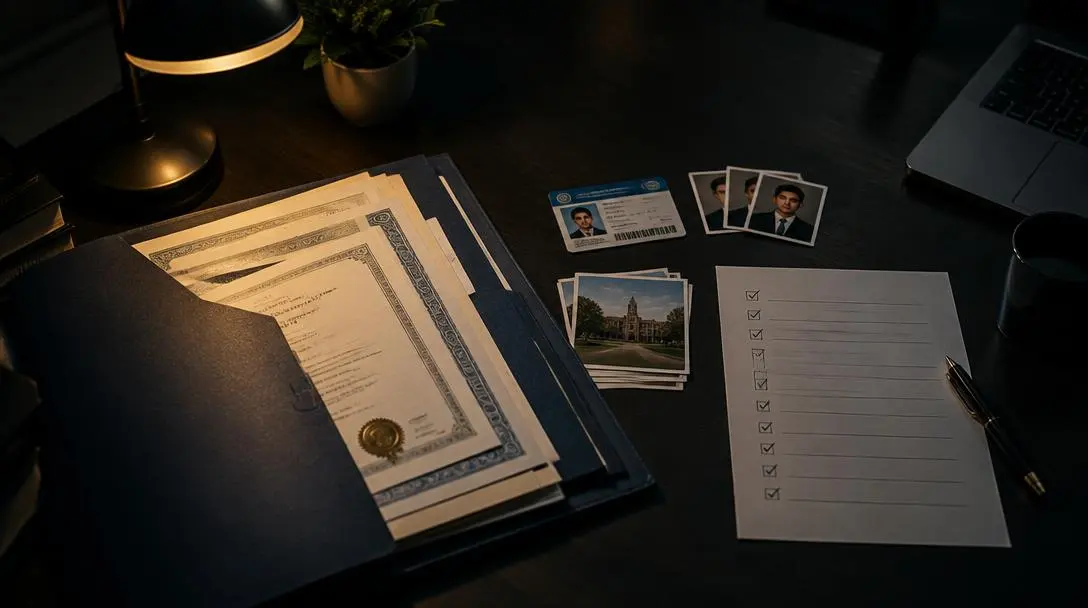
Every year between June and September, thousands of students in Karachi and across the country secure solid entry test scores, only to find their enrolments stalled at the registrar counter. The reason is rarely academic. It is almost always administrative: an un-attested intermediate marksheet, an expired CNIC, or a missing Permanent Residence Certificate. Gathering your university admission documents Pakistan requires dealing with multiple government bodies, distinct attestation workflows, and rigid bureaucratic timelines.
If you wait until the merit lists appear on noticeboards, you will find yourself running between the Board of Intermediate Education Karachi (BIEK), the Inter Board Coordination Commission (IBCC), and the Deputy Commissioner office during peak summer queues. This guide lays out the complete admission checklist, the exact attestation sequence you must follow, the real processing costs in Pakistani Rupees, and how to sidestep administrative hold-ups before deadlines close.
Essential University Admission Documents Pakistan Checklist: The Core Dossier
Regardless of whether you are applying to public sector giants like NED University of Engineering and Technology, the University of Karachi, and Dow University of Health Sciences, or private institutions like IBA, FAST-NUCES, or Habib University, you must prepare a foundational set of papers. Treat this as your base file:
- Matriculation / O Level Certificate and Statement of Results: You need the original certificate (Sanad) and the detailed marksheet (DMC). If your board has not issued the final Sanad yet, a provisional certificate issued by your school or board is mandatory.
- Intermediate / A Level Marks Sheet: For pre-medical, pre-engineering, computer science, or commerce streams, you need your Higher Secondary Certificate (HSC) Part-I and Part-II marksheets. If applying on a 'result-awaiting' basis, you must obtain a bona fide Hope Certificate on your college letterhead, signed and stamped by the principal.
- National Identity Documents: Your Computerised National Identity Card (CNIC) or Smart Card issued by NADRA. If you are under 18, your NADRA Child Registration Certificate (B-Form) accompanied by both parents' CNIC copies is compulsory.
- Passport-Sized Photographs: At least 12 to 16 recent passport-sized colour photographs with a sky blue or white background (Sindh public universities overwhelmingly specify blue backgrounds; check individual admission prospectus guidelines).
- Character Certificate: Issued by the head of the institution last attended, confirming conduct, discipline, and attendance records.
- Migration Certificate (NOC): Required if you completed your intermediate education under a board outside the university's immediate jurisdiction (for instance, moving from the Federal Board Islamabad to Karachi University, or from BISE Hyderabad to NED).
Board Attestation and the Correct Order of Operations
Attestation causes the most friction for candidates because it cannot be done out of order. Many students travel directly to the IBCC or the Higher Education Commission (HEC) office, only to be turned away at the gate because their foundational board stamps are missing.
Follow this linear chain strictly for all Pakistani education boards (BIEK, BISE Lahore, FBISE, etc.):
- 1Originating Board Verification: Take your original matric and intermediate marksheets and certificates to your respective board office (for example, the BIEK office at Bakhtiari Youth Centre in North Nazimabad, Karachi). You must submit a bank challan (typically ranging from PKR 1,000 to PKR 2,500 per document depending on whether you opt for regular or urgent delivery) and submit the original documents for internal verification. The board will verify them and return them with a sealed verification envelope or an official verification stamp on the reverse side.
- 2IBCC Attestation: Once your primary board has cleared and sealed or stamped your documents, you book an appointment with the Inter Board Coordination Commission. In Karachi, the regional office is located near the National Stadium. You must submit your original verified marksheets along with board verification slips. IBCC will not attest photocopies unless the originals carry their QR-code or embossed stamp.
Never break open a sealed verification envelope handed to you by an intermediate or matric board. If the seal is tampered with or broken before reaching the IBCC counter, the commission will reject the submission outright, and you will have to pay the board verification fee a second time.
Keep in mind that universities do not require HEC attestation for undergraduate admissions. HEC attests university degrees, not intermediate or high school marksheets. Do not waste days trying to book HEC appointments for pre-university papers.
IBCC Equivalence Certificate for O and A Level Students
If you sat for Cambridge Assessment International Education (CAIE), Pearson Edexcel, or International Baccalaureate examinations, Pakistani universities will not accept your raw grades directly. You must convert those letter grades into a percentage through an official IBCC equivalence certificate.
To secure your equivalence, assemble the following package:
- Original O Level Statement of Results and General Certificate of Education certificates.
- Original A Level Statement of Results and component certificates.
- Clear photocopies of your passport, CNIC/B-Form, and parents' CNIC.
- The online application form generated through the IBCC Equivalence Portal.
Processing times for standard equivalence take roughly 10 to 15 working days, while an urgent application generally takes 3 to 5 working days. Regular fees fall between PKR 3,000 and PKR 6,000 per qualification level (O Level and A Level are evaluated as two distinct qualifications, meaning two separate fees apply). Always check the latest fee schedule directly on the IBCC portal, as charges are revised periodically.
If your final A Level results are released in mid-August and your desired university closes applications in early August, obtain a provisional equivalence based on your O Level grades alongside a formal statement of entry for your A Levels. Most universities grant conditional admission, giving you two to four weeks post-result to submit the final equivalence document.
Domicile Certificate and PRC: The Sindh Quota Bottleneck
For students seeking entry into public universities in Sindh—including medical colleges governed by JSMU/DUHS, engineering institutes like NED and Dawood, and general universities like KU—the domicile certificate and Permanent Residence Certificate (PRC Form C and Form D) are non-negotiable.
Private universities rarely demand a domicile, but public universities allocate their open-merit and district-quota seats strictly against these documents. The candidate's domicile and PRC must correspond to the specific administrative district (such as Karachi Central, East, South, West, Malir, Korangi, or Keamari).
To secure these documents, you or your legal guardian must visit the Deputy Commissioner (DC) Office of your district with the following evidence:
- Applicant's CNIC or Smart B-Form.
- Father's CNIC and Father's Domicile/PRC (if the father is deceased, death certificate and mother's documents are required).
- Proof of residence: Registered utility bills (K-Electric, SSGC, or water board bills under the parent's or landlord's name), registered tenancy agreements, or property ownership documents.
- Educational certificates from primary school through intermediate showing continuous education within the district.
- Form P (for Domicile) and Form C/D (for PRC), purchased from the DC office or designated National Bank of Pakistan branches.
Processing takes anywhere between 7 to 25 working days. During admission season, backlogs at DC offices in Karachi run high. If you do not possess your domicile certificate by the end of your intermediate examinations, start the application process immediately. Do not wait for university entrance test results.
Medical Fitness, Affidavits, and Character Certificates
Beyond academic transcripts and state identification, admissions directories require a set of legal undertakings designed to protect the institution from campus disputes, union activism, and medical liability.
### Non-Involvement in Political Activities (Stamp Paper Affidavit)
Almost every public sector university in Pakistan requires an affidavit printed on non-judicial stamp paper, typically valued at PKR 50 or PKR 100. The text is usually provided as an annexure in the university prospectus. It states that you will not participate in political activities, strikes, or unauthorised demonstrations. This document must be typed, signed by you and your guardian, and attested by an Oath Commissioner or Notary Public. Notary counters outside district courts or civic centres charge an administrative fee of PKR 200 to PKR 500 for this service.
### Medical Fitness Certificate
Certain programmes—especially engineering, pharmacy, medical, and architecture disciplines—demand a certified fitness record. You must prove normal colour vision (vital for electrical engineering and pathology tracks), basic cardiovascular health, and general physical capability. In Sindh, institutions specify that this certificate must be signed by a Registered Medical Practitioner holding an active PMDC/PMC registration number, or issued by a government hospital (such as Civil Hospital Karachi, JPMC, or Abbasi Shaheed Hospital).
Managing University Admission Documents Pakistan: Timeline, Fees, and Attestation Order
To help you budget both your time and family expenses, the comparison table below outlines the primary credentials, where to procure them, realistic waiting periods, and representative cost ranges across Karachi and Sindh boards.
| Document Name | Issuing Authority | Standard Turnaround Time | Approximate Cost Range (PKR) | Key Prerequisite | :--- | :--- | :--- | :--- | :--- | Board Verification | BIEK / BISE / FBISE | 3 to 7 working days | PKR 1,000 - 2,500 per document | Original marksheet/Sanad | IBCC Attestation | IBCC Regional Centre | 1 to 5 working days | PKR 1,200 - 3,000 per document | Prior Board verification | IBCC Equivalence | IBCC Equivalence Wing | 3 to 15 working days | PKR 3,000 - 7,000 per level | Original CAIE/Edexcel papers | Domicile & PRC | DC Office (District level) | 10 to 25 working days | PKR 500 - 2,000 (Govt challan) | Parent's domicile & local bills | NADRA Smart Card | NADRA Executive Centre | 5 to 15 working days | PKR 750 - 2,500 | B-Form & parent biometric | Affidavits / Undertaking | Notary Public / Stamp Vendor | Same day | PKR 250 - 600 per stamp page | Prescribed university draft | Medical Certificate | Govt Hospital / PMDC Doctor | 1 to 2 working days | PKR 500 - 1,500 | Laboratory blood/chest tests |
|---|
Always plan your budget ahead: if you require urgent attestation across four certificates, equivalence for two levels, and new NADRA cards, administrative processing fees can easily cross PKR 15,000 to PKR 25,000 in total.
Common Delays and Fatal Mistakes to Avoid
Admissions offices discard hundreds of applications every semester due to clerical oversights that candidates fail to catch. Guard against these four frequent errors:
### 1. Name and Father Name Discrepancies
If your matriculation marksheet spells your name with an extra letter compared to your NADRA B-Form, or your father's surname is truncated on your intermediate certificate, the admissions portal will flag your file. Resolving a spelling discrepancy at the board office requires newspaper classified notices, legal affidavits, and up to two months of processing. Audit your papers right now: ensure spelling, dates of birth, and parents' names match down to the exact letter across every single card and marksheet.
### 2. Missing Attestations on Photocopies
Universities require multiple sets of photocopies along with your original documents for verification. Unless specified otherwise, every photocopy submitted must be attested on the reverse by a Gazetted Government Officer (BPS-17 or above). Make at least five full photocopy dossiers and get them stamped in one sitting by an authorized college professor, school principal, or government doctor to avoid frantic runs on submission day.
### 3. Expired CNICs of Parents
When applying for quota seats or preparing financial verification for merit-based aid and scholarships, your parents' national identification cards will be thoroughly reviewed. If your father or mother holds an expired CNIC, NADRA services and university portals will reject the submission. Check the expiry dates on both parents' identity cards at the start of your final school term.
### 4. Overlooking the Migration Certificate (NOC)
If you sat for your intermediate examinations under the Federal Board in Islamabad or a regional board like BISE Mirpurkhas, and you plan to enrol at Karachi University, you must submit an official Migration Certificate from your parent board. Without it, your final semester enrolment remains provisional, and your university will withhold your transcript.
Print-Ready Admission Checklist: Final Verification Before Submission
Before you head out to deposit your admission docket at the university counter or upload your scans online, print this section out and tick every single box.
- [ ] 4 sets of clear photocopies of SSC / Matric marksheet and Sanad (BPS-17 attested).
- [ ] 4 sets of clear photocopies of HSC / Inter marksheet or Hope Certificate (BPS-17 attested).
- [ ] Original IBCC equivalence certificate and 3 photocopies (for foreign qualifications).
- [ ] Original Intermediate / Matric documents with visible IBCC attestation stamps on the reverse.
- [ ] Candidate's CNIC / NADRA Smart Card (original + 4 copies).
- [ ] Father's / Guardian's CNIC (4 copies).
- [ ] Candidate's Domicile Certificate and PRC Form C (original + 3 copies for public quota).
- [ ] 12 recent passport-sized photographs with the background colour required by your target institution.
- [ ] Character certificate from the college/school principal (original + 2 copies).
- [ ] Original bank payment voucher/challan of the university entrance test or processing fee.
- [ ] Duly signed legal affidavit on stamped paper attested by an authorized Oath Commissioner.
- [ ] Medical fitness report signed by a PMDC registered physician.
- [ ] Migration Certificate (NOC) if shifting across educational boards or provinces.
Organise your originals in a waterproof plastic folder, and store each attested photocopy dossier in an individual paper sleeve. Explore our resources section for printable templates, read our breakdown of post-HSC academic paths in our courses directory, or review upcoming entrance test schedules in our blog. Getting your paperwork right early lets you focus on what actually matters: your test prep, your interview, and securing your place.
Questions students ask about this topic
Keep reading
- AdmissionsNUST vs NED vs GIKI: Choosing an Engineering University in PakistanA realistic, Karachi-focused guide to choosing between NUST, NED, and GIKI, covering entry test math, total expenses, hostel survival, and job placements.
- AdmissionsFAST NUCES Admission Test: What the Paper Actually AsksA comprehensive, realistic guide to surviving the FAST NUCES admission test, covering advanced maths requirements, negative marking, and campus-specific merit realities.
- AdmissionsIBA Karachi Aptitude Test: A Realistic Preparation PlanA realistic, Karachi-focused guide to clearing the IBA Karachi aptitude test, covering section breakdowns, prep schedules, cut-offs, and financial aid.