Improvement Exams: Fixing a Bad Intermediate Result
A complete, board-by-board guide to appearing in an intermediate improvement exam in Pakistan, covering BIEK, FBISE, admission deductions, and gap year trade-offs.
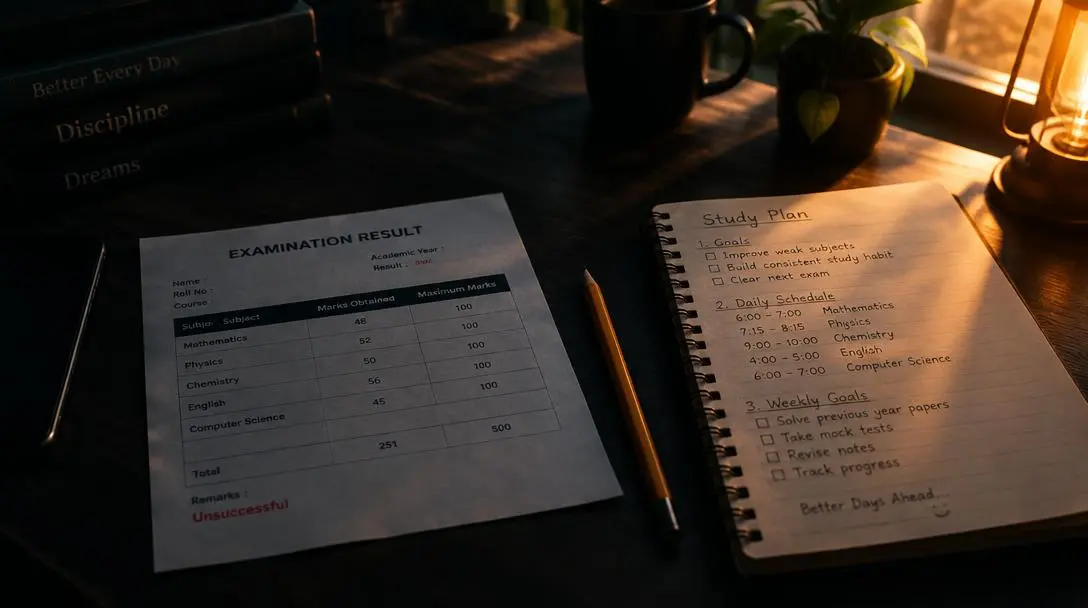
Receiving an intermediate mark sheet that falls short of university admission cut-offs is a gut-punch. Whether you missed out on an MBBS seat by two marks, missed the 60 percent benchmark for computing programmes, or ended up with a C grade in Pre-Engineering, sitting for an improvement exam Pakistan offers a legal, structured second chance to repair your academic standing.
However, repeating intermediate papers is not a simple weekend decision. It carries strict board-specific regulations, financial expenses, gap year risks, and complex timing issues with university entrance tests. Before you submit a form to the Board of Intermediate Education Karachi (BIEK) or the Federal Board of Intermediate and Secondary Education (FBISE), you must understand the rules, the hidden costs, and whether local universities will view your improved certificate differently.
Understanding the Improvement Exam Pakistan: What It Actually Means
An improvement exam is a formal process allowing a candidate who has already cleared their Higher Secondary School Certificate (HSSC-II) to re-appear in one or more subjects to raise their total aggregate. It is fundamentally different from sitting as an ex-student due to failing.
The most critical protection across almost all Pakistani boards is the 'rule of better marks'. If you appear for an improvement exam and happen to score lower than your original score, your board retains your higher previous mark on your official transcript. Your aggregate will not drop simply because you had a bad day in the examination hall. However, if your marks improve, the board cancels the previous certificate and issues a revised one reflecting the higher numbers.
Note: In almost all boards, once your new result card is issued after an improvement attempt, the mark sheet usually mentions 'Appeared as an Improver' or issues a certificate that indicates the revised session. Universities and professional councils know how to read these codes.
If you are debating whether an improvement is your only route to your chosen career path, explore our comprehensive careers portal to see alternate fields where your current score might already meet direct entry requirements.
Board Result Recheck vs Improvement Exam: Which Should You Choose?
Before locking yourself into six months of intensive revision, determine whether you genuinely need to re-sit the papers or if you should first request a board result recheck.
A board recheck in Pakistan does not mean an examiner re-reads your essays and awards subjective marks. Board regulations throughout Sindh and the Federal system strictly define 'scrutiny' or 'rechecking' as administrative recalculation. During a scrutiny process, the board staff confirms the following:
- All questions written in your answer booklet were marked and not skipped by the examiner.
- The marks written on individual pages were transferred correctly to the title page of the answer booklet.
- The addition of all sub-marks matches the grand total entered into the board's database.
Scrutiny fees generally range from PKR 500 to PKR 1,500 per paper depending on the board. While clerical errors do happen, rechecking rarely increases a student's aggregate by more than three to five marks. If you need a 10 to 15 percent jump to qualify for university admissions, a scrutiny form will not solve your problem. You must sit for an improvement exam instead.
Supplementary Exam vs Improvement Exam: Clearing the Confusion
Students frequently confuse sitting for an improvement with appearing in a supplementary exam (now often termed the 'Second Annual Examination').
A supplementary exam is strictly designed for students who failed one or two papers and need to pass to earn their basic HSSC certificate. In contrast, an improvement exam is strictly for candidates who have already passed the entire HSSC examination without any failing subjects.
Previously, boards required students to wait an entire calendar year to appear during the next First Annual Examination. Today, boards such as FBISE and select boards in Punjab allow eligible students to register for improvement in the Second Annual Examination held later the same year. In Karachi, however, BIEK rules regarding who can appear in the second annual exam can change from year to year; you must confirm whether improvers are permitted in the immediate second cycle or must wait for the subsequent main annual examination.
Rules and Eligibility by Board: BIEK Karachi vs FBISE
The regulatory landscape for an improvement exam in Pakistan depends entirely on your registering board. A student under the Federal Board in Islamabad or Karachi has vastly different options compared to a student enrolled with BIEK.
### Board of Intermediate Education Karachi (BIEK)
BIEK enforces stricter limitations on how and when you can improve:
- Time Window: You typically have one year (or two consecutive examination opportunities) following the declaration of your complete HSSC-II result to register for improvement.
- Subject Grouping: BIEK generally permits students to improve either all subjects of Part 1, all subjects of Part 2, the entire HSSC course (all papers of Part 1 and Part 2 together), or individual science/elective subjects.
- Practical Examinations: If you choose to improve a science subject that includes practicals (such as Physics, Chemistry, or Biology), you often must sit for both the theoretical paper and the practical laboratory exam.
- Fees: Expect base registration fees to range between PKR 2,500 and PKR 6,000 depending on whether you improve selective papers or the full group, plus extra charges for late forms.
### Federal Board (FBISE Islamabad)
FBISE has modernized its examination framework significantly over the past three years:
- Multiple Attempts: Under updated regulations, FBISE allows candidates multiple improvement opportunities within a period of up to four years from passing HSSC, provided the candidate has not acquired a higher qualification (such as an associate or bachelor's degree) in the interim.
- Paper Choice: You can choose to improve individual papers (e.g., Mathematics Part 1 only, or Chemistry Part 2 only), specific parts, or the full certificate.
- Second Annual Access: FBISE candidates can sit for their improvement exam in the Second Annual exams conducted in autumn, cutting down wait times.
You can find previous papers and syllabus breakdowns for both boards inside our curated resources section.
Comparison: Improvement Exam Policies Across Major Pakistani Boards
The table below summarises how improvement exams work across the three primary examination ecosystems accessed by Pakistani students.
| Board / System | Eligibility Window | Paper Selection Flexibility | Second Annual Access for Improvers | Approximate Fee Range |
|---|---|---|---|---|
| BIEK (Karachi Board) | Within 1 year of passing HSSC | Whole Part 1, Whole Part 2, Full course, or selective subject groups | Subject to yearly board policy (historically restricted) | PKR 2,500 – PKR 6,500 |
| FBISE (Federal Board) | Up to 4 years before higher degree | Highly flexible; single subjects, single papers, or full group | Yes, fully permitted in Second Annual | PKR 3,000 – PKR 8,000 |
| Punjab BISE Boards | Up to 3 to 4 attempts within 3 years | Single subjects, full part, or entire 12-year aggregate | Yes, routinely permitted in Second Annual | PKR 2,500 – PKR 7,000 |
Always confirm these parameters by collecting the latest gazette or official notification from your board's facilitation centre before paying bank challans, as policies are revised periodically by intermediate chairmen committees.
How to Improve Intermediate Marks: Subject Selection Strategy
When strategising how to improve intermediate marks, many students make the critical mistake of taking on too many papers. Registering for all seven subjects across both Part 1 and Part 2 usually leads to burnout and marginal score gains.
- 1Audit Your Mark Sheet: Calculate the exact marks needed to clear your target threshold. If you need 40 additional marks to reach 70 percent, calculate which combination of subjects provides the highest statistical probability of delivering that surplus.
- 2Prioritise High-Ceiling Subjects: Mathematics, Computer Science, and Physics problems are graded objectively. If your method is correct, you can score 95 percent or higher. In contrast, subjective humanities and languages (Urdu, English, Islamiat) rarely see dramatic increases from board examiners.
- 3Improve Part 1 Papers if Permitted: Part 1 concepts are generally foundational and easier to master during revision than advanced Part 2 topics. Improving your 11th-grade theory can rapidly bolster your aggregate.
- 4Treat Practicals Seriously: Practicals can swing your aggregate by up to 10 to 15 marks. Do not assume your old practical marks will automatically shield you if your board mandates a retake of the laboratory exam alongside theory.
If you are balancing your preparation while trying to figure out which academic major suits your learning style, take our short quiz to map your skills to suitable undergraduate pathways.
The University Admissions Reality: Do Universities Care or Penalise You?
A widespread myth among intermediate students is that top universities reject candidates who present an improved mark sheet. This is incorrect, but nuances exist across medical, engineering, and private institutions.
### Medical & Dental Colleges (MDCAT Pathway)
The Pakistan Medical and Dental Council (PMDC) and admitting provincial bodies—such as Dow University of Health Sciences (DUHS) in Sindh or UHS in Punjab—accept improved certificates without institutional bias. They calculate your intermediate weighting strictly from the final marks reflected on your revised official mark sheet. There is no percentage deduction simply for having appeared as an improver.
### Public Engineering & Technology Universities
Institutions like NED University of Engineering and Technology (Karachi), NUST (Islamabad), and UET (Lahore) judge your eligibility based on the final equivalence or board certificate. However, timing is the real enemy here. Most engineering universities wrap up admissions between July and September. If your improvement exam result is declared in October or November, you cannot use those higher marks for that current year's cycle; you must wait for the following year's admissions.
### Private and Computing Institutions
Institutions such as FAST-NUCES, IBA Karachi, Habib University, and LUMS prioritize their own aptitude tests and entry assessments. While they demand minimum board percentages (typically 60 to 70 percent depending on the discipline), they do not deduct marks for improved attempts. As long as your final board document satisfies their equivalence criteria before their stated deadline, your admission stands.
If finances during this extended preparation phase are a concern, look through our updated list of local scholarships to see which providers offer support based on revised merit.
The Timing Trap: Gap Years, Paper Overlaps, and Deadlines
The hardest trade-off when taking an improvement exam Pakistan is managing the calendar. Many candidates find themselves stranded midway through the academic year due to overlapping schedules.
Consider this realistic scenario: you receive your HSSC-II result in August. You immediately apply for improvement in the Second Annual Examination or the subsequent First Annual Examination. Meanwhile, the university admissions you hoped to unlock are already closing their document submission portals.
If you decide to improve:
- You must commit mentally to a gap year. If you attempt to attend university on a provisional basis while quietly studying for improvement papers, you will likely compromise both your GPA and your board exam.
- Be prepared for entrance test validity conflicts. For example, MDCAT scores typically remain valid for a specified window under current PMDC policies. If you re-sit intermediate, you may also need to retake the entrance test to keep both scores aligned within the same cycle.
- Account for document delays. Once results are declared, receiving your revised marks certificate from BIEK or other provincial boards can take anywhere from four to eight weeks, requiring repeated visits to board offices.
Read our analytical guides on the blog to see how past students managed their gap year schedules effectively without losing study momentum.
Step-by-Step: How to Register for an Improvement Exam Pakistan
If you have weighed the risks and decided to move forward, follow this structured administrative sequence to submit your application without errors:
- 1Confirm Your Eligibility Window: Check your original passing date against your board's current regulations. Ensure you have not exceeded the allowed interval or completed a higher academic degree.
- 2Obtain the Improvement Form: Download the designated HSSC Improvement Examination Form from your board's official website (e.g., biek.edu.pk or fbise.edu.pk) or purchase it from the board's designated bank branches (such as HBL, NBP, or Askari Bank branches linked to the board).
- 3Select Your Papers Accurately: Fill in the correct subject codes for Part 1, Part 2, or both. Be extremely careful when specifying whether you are appearing for theory, practical, or both.
- 4Pay the Prescribed Challan: Generate the bank challan. Improvement fees vary depending on the number of papers, practical components, and late-fee brackets. Expect an expenditure of PKR 3,000 to PKR 8,000. Keep your bank stamped copy safe.
- 5Attach Required Documents: Boards generally require your original matriculation certificate, original HSSC-I and HSSC-II marks sheets, recent passport-sized photographs attested by a college principal or a Grade-17 gazetted officer, and a copy of your CNIC or B-Form.
- 6Submit to the Board: Submit the packet directly to the board's physical counter or send it through registered mail/courier as specified by your board's regional office instructions.
- 7Track Roll Number Slips: Monitor the board's online portal roughly three weeks before examinations commence to download and print your admit card, ensuring all registered subjects appear correctly.
Improving your intermediate result requires honest self-reflection. If your lower marks resulted from lack of discipline, poor exam strategy, or a health crisis that is now resolved, repeating those papers is a viable, high-reward move. Execute your preparation methodically, keep a close eye on university admission cycles, and make every additional paper count.
Questions students ask about this topic
Keep reading
- Exam PrepMDCAT Preparation Timeline: Class 11 to Test DayA realistic MDCAT preparation timeline for Pakistani students, stage by stage from the first week of Class 11 to the final fortnight before the test.
- Exam PrepA 60-Day Sindh Board Exam Revision StrategySixty days is enough for a complete revision cycle — if you stop starting from Chapter One every time. A three-cycle plan for Sindh Board Class 9 to 12 papers.
- Exam PrepMDCAT or ECAT: Choosing Your Entry Test Before Class 11 StartsThe entry test you will sit in two years should influence the group you pick today. A plain comparison of MDCAT and ECAT for students in Karachi.