Learning to Code From Class 9: A Twelve-Month Path
A practical twelve-month roadmap for Class 9 students in Pakistan to learn Python, manage board exam pressure, and build their first software projects.
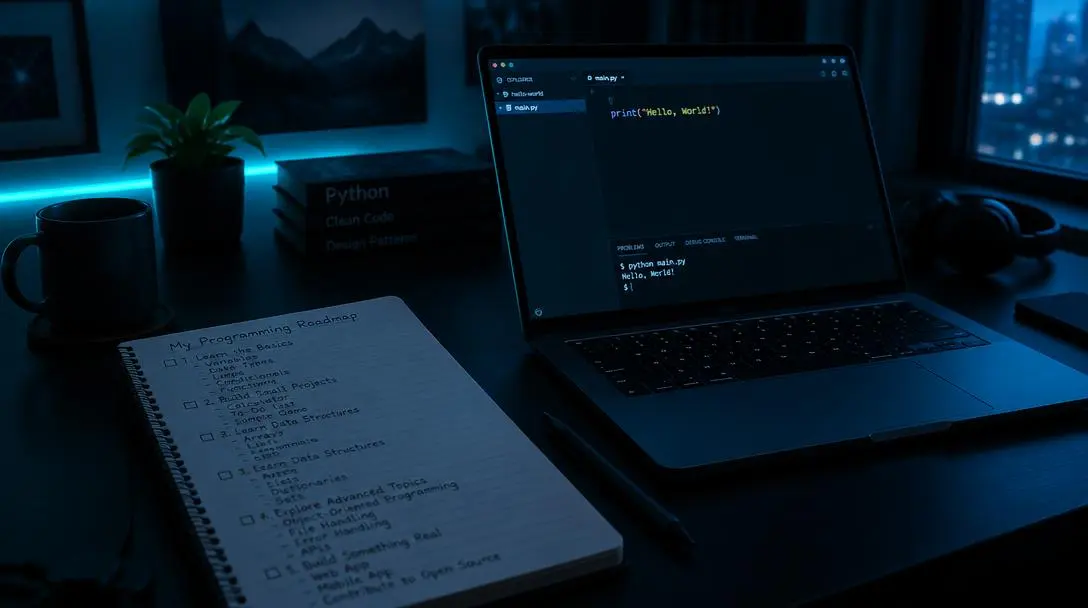
Stepping into Class 9 is often treated as the start of an academic pressure cooker in Pakistan. Between morning school, evening tuition centres, and the looming reality of board exams, finding time for an extra technical skill might feel unrealistic. Yet, learning to code during this transition year gives you a distinct advantage. If your ambition is to master modern computer science, starting early allows you to learn through experimentation rather than cramming. With the right roadmap to learn programming for beginners Pakistan, you can comfortably master core software concepts in twelve months without compromising your school grades.
The secret lies in treating code like an instrument: steady, low-intensity practice beats weekend-long marathons that leave you exhausted before Monday morning classes.
Why Learn Programming for Beginners Pakistan Starts Best in Class 9
Class 9 is the sweet spot in the Pakistani school cycle. If you are enrolled in the Sindh Board (BSEK), Federal Board (FBISE), or Cambridge O Levels, your syllabus broadens significantly, but the high-stakes finality of matriculation or college entrance exams is still a year or two away. By the time you reach Class 11 (First Year) or A Levels, entry test prep for universities like FAST-NUCES, NED University of Engineering and Technology, or NUST will claim the majority of your discretionary study hours.
Starting coding for class 9 trains your brain in algorithmic thinking well before you encounter rigid curriculum requirements. Matric Computer Science curricula frequently mandate outdated theory or basic C/C++ syntax memorisation on paper without giving you adequate lab time. When you build software independently at home, school computer practicals transform from intimidating chores into effortless exercises.
Moreover, programming demystifies the digital world. Instead of simply consuming apps and games on your phone, you begin to grasp how software operates underneath the interface. That shift in perspective alters how you approach mathematics, physics, and logical problem-solving across your regular subjects.
The Language Question: Python, C++, or Web Development?
Beginners often waste weeks debating which language will land them high-paying freelance gigs right away. For a secondary school student, this is the wrong question. Your objective in the first year is to learn fundamental computational thinking—loops, variables, conditionals, data structures, and debugging. Once you understand these, migrating to another language takes weeks, not months.
For almost every teenager in Pakistan, Python is the sensible choice. Python for students removes the punishing syntax overhead of semi-colons, memory allocation, and type declarations found in older languages. It reads closely to plain English, which means you can concentrate on logic rather than fighting compiler errors.
| Pathway | Pros for Pakistani Students | Cons & Drawbacks | Best For |
|---|---|---|---|
| Python | Minimal syntax, massive ecosystem, excellent libraries, fast feedback loop | Slower execution, not the default language for Sindh Board theory | Logic building, data analysis, automation, script writing |
| C++ / C | Aligns directly with FBISE/Sindh Board computer textbooks, teaches memory | Steep learning curve, frustrating syntax errors for young beginners | Board exam prep, competitive programming later on |
| HTML/CSS/JavaScript | Immediate visual results in the browser, quick path to website layout | JavaScript quirks can confuse beginners; CSS is layout, not logic | Visual learners interested exclusively in front-end web design |
While learning C++ gives you an edge in specific board exams that still test it, starting directly with C++ often discourages students who do not have an experienced tutor sitting beside them. Master Python first; return to C++ when your board syllabus demands it.
Hardware and Setup: What You Actually Need in Karachi
You do not need a gaming rig or a high-end MacBook to learn programming. Python, code editors, and command-line tools will run smoothly on modest hardware. A refurbished business laptop (such as a Lenovo ThinkPad or Dell Latitude with an Intel Core i3 or i5 fourth-generation processor or higher, and 8 GB of RAM) is more than sufficient. You can find these in secondary computer markets, such as Karachi's Techno City or Regal Chowk, generally ranging between PKR 30,000 and PKR 45,000.
Keep your power setup in mind. Load-shedding is an everyday reality in most Pakistani cities. Ensure your laptop battery holds at least an hour of charge, or set up a basic UPS connection so an abrupt power outage does not corrupt your active development environment or cause you to lose unsaved progress.
Avoid programming on mobile phones or tablets whenever possible. While text-editing apps exist for Android, programming requires fast typing, multiple windows open side-by-side, access to a terminal, and file system management. A real keyboard and desktop operating system (Windows or Linux) are essential tools of the trade.
The Twelve-Month Roadmap to Learn Programming for Beginners Pakistan
A year gives you enough breathing room to study without burning out. Split your year into four distinct phases, keeping your school midterm and final exam schedules firmly in mind.
### Phase 1: Foundations and Logic (Months 1 to 3)
Your goal during the first quarter is to become comfortable writing basic instructions and running scripts in a local text editor like VS Code.
- Week 1 to 4: Variables, primitive data types (integers, floats, strings, booleans), basic math operations, and user input via the terminal.
- Week 5 to 8: Conditional statements (`if`, `elif`, `else`) and comparison operators. Writing decision-making programs (such as simple tax calculators or grade evaluators).
- Week 9 to 12: Loops (`for` and `while`) and loop controls (`break`, `continue`). Practise building text-based guessing games, simple timers, and multiplication table generators.
### Phase 2: Collections and Functions (Months 4 to 6)
Once you can command basic logic, you need to organise data cleanly and write reusable code.
- Week 13 to 16: Data structures—lists, tuples, sets, and dictionaries. Learn how to search, slice, update, and sort data held inside memory.
- Week 17 to 20: Functions, parameters, return values, and scope. Stop repeating code by grouping logic into clean, modular components.
- Week 21 to 24: Basic error handling (`try` and `except`) alongside reading from and writing to local `.txt` and `.csv` files.
### Phase 3: Your First Programming Project (Months 7 to 9)
This is where most students get stuck because following tutorials feels comfortable, whereas building independently feels difficult. Break out of tutorial dependence by constructing your first programming project from scratch.
- Build a command-line student record system: Create a script that allows a user to add a student's name, roll number, and marks, save the data to a local file, search for existing records, and calculate class averages.
- Build a local utility tool: Write a Python automation script that sorts messy desktop files into neat folders (e.g., categorising `.pdf`, `.jpg`, and `.docx` files automatically).
- Focus on debugging: When an error code appears in your terminal, resist the urge to immediately copy-paste the problem into an AI prompt. Read the traceback line by line, identify the offending syntax, and use search engines to understand the underlying cause.
### Phase 4: Version Control and Expansion (Months 10 to 12)
In your final quarter, broaden your horizon into developer tools and pick a practical direction that excites you.
- Learn Git and GitHub: Understand the commands `git init`, `add`, `commit`, and `push`. Store your scripts online to build a public record of your progress.
- Explore a focused domain: Either build interactive desktop apps using Python's `Tkinter` library, or learn the absolute basics of HTML and CSS to see how front-end code interacts with back-end logic.
- Reserve Month 12 for board prep: Put programming on ice entirely 4 to 6 weeks before your Class 9 board or final school exams. Your code will wait for you; your matric score sheet will not.
Balancing Board Exams, School Work, and Weekly Coding Hours
Burnout is the primary reason Pakistani teenagers drop out of self-taught programming courses. When you attempt to juggle 6 hours of coaching centre classes, school homework, and 3 hours of late-night coding, your health and school performance deteriorate quickly.
- Cap your coding time at 4 to 6 hours per week: Dedicate two one-hour sessions on weekday afternoons and one three-hour block on Saturday or Sunday morning.
- Coordinate with your academic calendar: The academic year in Karachi generally intensifies between December (midterms) and March/April (Sindh Board and Cambridge exams). Reduce your coding commitments to zero during high-stress exam months. Do not feel guilty about taking a four-week break.
- Protect your sleep: Writing code past midnight when you have 7:30 AM assembly the next day leads to cognitive fatigue. Code with a fresh mind on weekend mornings instead.
Review our guide on study resources to help streamline your school revision techniques so you can free up consistent time for coding.
Free Resources Tailored for Pakistani Students
You do not need to pay thousands of rupees to private institutes in Clifton, Gulshan, or Saddar for entry-level programming courses. The highest quality learning materials on the planet are completely free.
- Harvard's CS50x (edX): The gold standard for foundational computer science. The lectures are entertaining, conceptually rigorous, and available for free without paying for the verified certificate.
- FreeCodeCamp & The Python Tutorial (Official Docs): Clear, text-based guides that consume very little internet bandwidth, making them ideal if your home connection fluctuates.
- YouTube Channels: Channels like *Corey Schafer* (for deep Python explanations) and *Programming with Mosh* (for beginner walkthroughs) provide practical examples without paywalls.
- Community Platforms: Join technical student groups or participate in national platforms like the National Youth Tech Contests or local hackathons arranged by university ACM chapters to observe how seniors work.
If you ever seek structured paths beyond self-study, browse available program courses and check for potential tech scholarships available to Pakistani secondary students.
Common Traps: Tutorial Hell, Costly Bootcamps, and Board Stress
Avoid the commercial academy trap. Several private coaching centres in urban centres advertise 2-month summer coding certificates aimed at school children, charging anywhere from PKR 15,000 to PKR 50,000. Most of these programmes do little more than hand out outdated slide decks and step-by-step code snippets that students retype without understanding.
Another common obstacle is "tutorial hell"—the habit of watching dozens of coding videos on YouTube while never opening an empty file in an editor to write logic yourself. Coding is an active skill. If you spend two hours watching someone else code, spend three hours attempting to recreate that project from memory, intentionally breaking lines to observe how the program fails.
Lastly, remain realistic about your immediate outcomes. Learning to code in Class 9 will not turn you into a high-earning software freelancer by Class 10. The freelance marketplace requires specialised client-handling skills, advanced frameworks, and reliable portfolios. Treat this year as an investment in your foundational intelligence. When you eventually apply to top-tier computer science programmes at FAST, GIKI, or IBA Karachi, or transition into tech careers, the twelve months you spent building simple scripts in Class 9 will place you miles ahead of peers who only touched their first line of code during university orientation.
Take our tech suitability quiz to evaluate your current technical inclinations and determine which area of software development matches your analytical strengths.
Questions students ask about this topic
Keep reading
- SkillsFreelancing for Students in Pakistan: A Safe First YearA practical first-year roadmap to freelancing for matric, intermediate, and A Level students in Pakistan without ruining exam scores or falling for online scams.
- SkillsSpeaking English Confidently: A Practice Plan for Shy StudentsA step-by-step solo practice protocol for shy Pakistani students looking to speak English fluently in class, vivas, and university entrance interviews.
- SkillsDigital Literacy and Online Safety for StudentsA practical guide for Pakistani matric, inter, and A-Level students on safeguarding social accounts, spotting entry test scams, and managing screen time.