Building a Study Plan That Survives a Full School Day
Most timetables fail in week two because they assume unlimited energy. Here is how to design a plan around the hours you actually have, and how to rebuild it when it breaks.
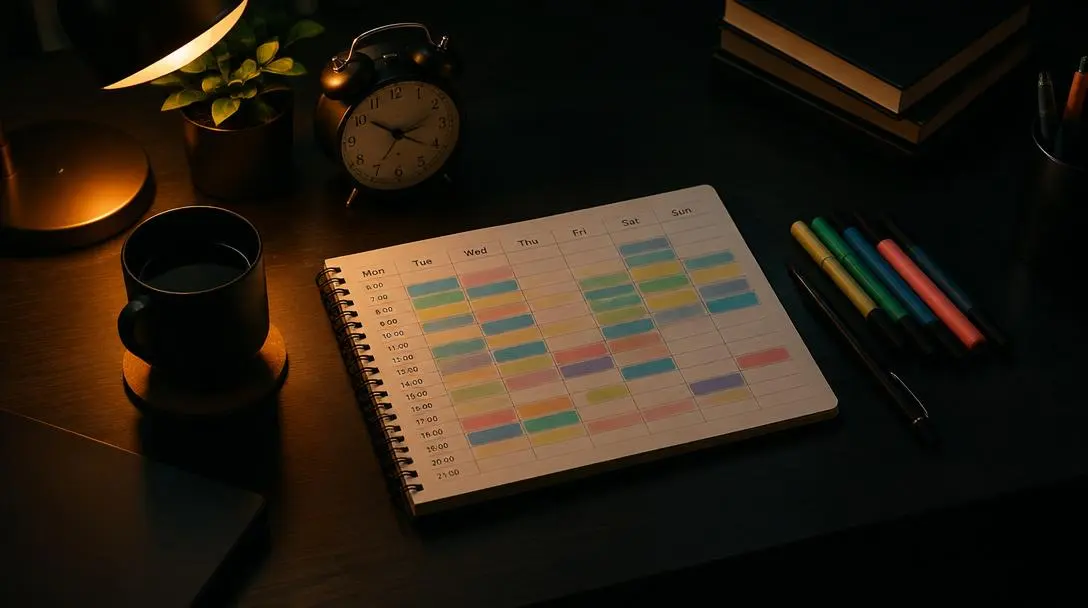
The most common study plan we see is a colour-coded grid promising eight hours of daily revision on top of school. It is beautiful, and it is dead within nine days. Not because the student lacked discipline, but because the plan was written by an optimist who had already forgotten what a school day feels like.
A plan that survives is built from subtraction, not ambition.
Step one: count the hours you actually own
Take a normal weekday and subtract everything that is not negotiable.
- School and assembly: usually 6 to 7 hours.
- Commute in Karachi traffic: 1 to 2 hours.
- Meals, prayers, household duties: 1.5 to 2 hours.
- Sleep, at eight hours, because cutting it destroys retention faster than any timetable can rebuild it.
What remains for most Class 9–12 students is two and a half to three and a half hours. That is your real budget. Plan for three and protect them, and you will outperform the student who planned for eight and delivered two.
Step two: split the block into deep work and review
Divide your daily budget into three parts.
- 1Deep block one — 50 minutes. New or difficult material only. Phone in another room, not face down on the desk.
- 2Deep block two — 50 minutes. Problem practice for a numerical subject: Maths, Physics, Accounting or Chemistry numericals.
- 3Review block — 30 minutes. Yesterday's and last week's material, using recall rather than rereading.
Ten minutes of genuine break sits between the blocks. A break means standing up and leaving the desk. Scrolling is not a break; it is a different kind of load on the same attention system.
Step three: make the review block active
This is where most of the compounding happens, and where most students waste their time.
Rereading notes produces a strong feeling of familiarity and weak actual recall. Instead, close the book and write down everything you remember about the topic on a blank page. Then open the book and mark, in a different colour, what you missed. The gaps you find are your real syllabus.
Retrieval feels harder than rereading and is roughly twice as effective per minute. If your revision feels comfortable, it is probably not working.
For definition-heavy subjects such as Biology, Pakistan Studies or Islamiat, write your own question cards and shuffle them. For numerical subjects, redo a solved example with the solution covered before attempting new questions.
Step four: build in the buffer
Something will always go wrong. A surprise class test, a wedding, illness, a load-shedding evening, Eid. The plan needs somewhere for that to land.
Keep one 90-minute buffer session each week — usually Friday evening or Sunday morning — with nothing scheduled in it. If the week went perfectly, you use it for paper practice. If it did not, you use it to catch up. The buffer is the single feature that separates plans that last a term from plans that last a fortnight.
Step five: the weekly review, fifteen minutes
Every Sunday, answer three questions in writing.
- Which sessions did I actually complete, and which did I skip?
- Which topic am I still avoiding, and why?
- What is the one change for next week?
One change. Not five. A plan improves by small correction, and the topic you keep avoiding is almost always the one carrying the most marks in your weakest paper.
Handling tuition without losing your evenings
Most Karachi students in Class 11 and 12 attend academy classes. Tuition is passive time — you are receiving explanation, not building recall — so it does not replace your deep blocks.
If tuition runs three evenings a week, shrink those days to one deep block plus review, and move the second deep block to your lighter days. Trying to run a full schedule on top of an academy evening is how burnout starts in October.
A worked example for a Class 11 Pre-Engineering student
- Monday, Wednesday, Friday: Maths deep block, Physics problems, review of yesterday.
- Tuesday, Thursday: academy in the evening; one Chemistry deep block before it and a 20-minute review after.
- Saturday: one full past-paper section under timed conditions, then marking.
- Sunday: 90-minute buffer plus the 15-minute weekly review.
That is roughly 18 focused hours a week. Sustained across a term it beats any three-week sprint, and it leaves you with a life, which is the part that keeps you going in Class 12.
Questions students ask about this topic
Keep reading
- Study SkillsStudying Online Safely: Privacy, Scams and Screen DisciplineOnline study is now the default for Class 9–12 students in Pakistan. Here is how to protect your accounts, spot education scams and keep your phone from eating your revision.
- Study SkillsA Class 9 Study Routine That Survives a Full School DayMost Class 9 timetables collapse in three weeks because they are built for an imaginary student. Here is a routine built around a real Karachi school day, tuition and all.
- Study SkillsSindh Board Matric Revision Plan for the Final 60 DaysA structured 60-day day-by-day study schedule and past-paper revision system built specifically for Sindh Board matric candidates.