A Levels vs FSc: Cost, Difficulty and University Access
A detailed comparison of A Levels vs FSc in Pakistan covering IBCC equivalence mechanics, entry test impact, real costs, and university pathways.
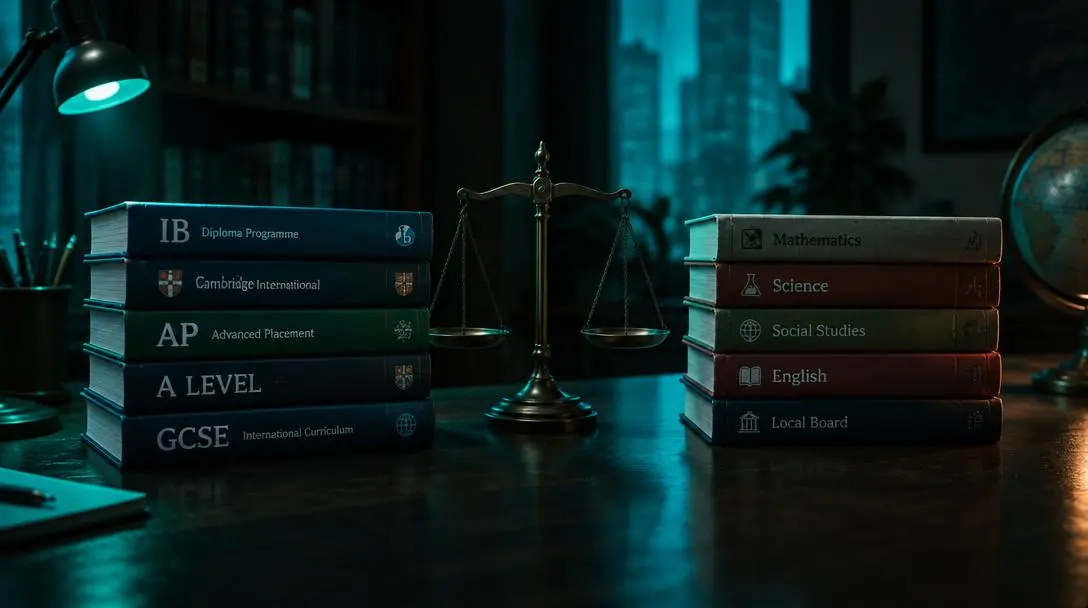
Every year across Pakistan, students finishing Class 10 Matric or Cambridge O Levels face the same dilemma: should you enroll in intermediate or continue with British qualifications? The debate over A Levels vs FSc is rarely just about academic difficulty. It is a decision that dictates your financial investment over the next twenty-four months, your daily study habits, and how easily you can compete for a seat at local public universities versus institutions abroad.
Making the wrong choice can leave you scrambling with syllabus mismatches during entry tests or facing an unexpected disadvantage during equivalence calculation. Here is a breakdown of how the two pathways compare in difficulty, practical costs, equivalence mathematics, and long-term university access.
A Levels vs FSc: Understanding the Core Differences
The fundamental difference between General Certificate of Education (GCE) Advanced Levels and the Higher Secondary School Certificate (HSSC/FSc) lies in how knowledge is tested.
FSc, whether taken through the Federal Board (FBISE), the Board of Intermediate Education Karachi (BIEK), or a Punjab board, is largely textbook-bound. Your board examinations evaluate how thoroughly you have retained the topics, derivations, formulas, and diagrams printed in your provincial textbook. The marking scheme demands specific phrasing, standard diagram layouts, and structured long-answer responses. For many students, this rewards consistent memorisation and syllabus coverage.
A Levels, administered primarily by Cambridge Assessment International Education (CAIE), tests application over recall. You are expected to apply concepts to unfamiliar data sets, write concise scientific explanations, and work through complex problem sets. In subjects like Physics and Chemistry, practical papers require independent experimental setup and error evaluation under strict lab conditions.
This difference impacts your workload drastically:
- Subject count: FSc requires six subjects (three electives such as Physics, Chemistry, Biology/Maths, alongside compulsory Urdu, English, and Pakistan Studies/Islamiat). A Levels typically requires three or four subjects total.
- Exam frequency: Intermediate students sit exams in two distinct parts (First Year and Second Year). A Level students can either take a staged route (AS Level at the end of Year 1, A2 at Year 2) or sit linear exams at the end of the two-year course.
- Syllabus changes: CAIE updates syllabuses on strict three- to five-year cycles with clear command words and specimen papers. Intermediate boards update textbooks less frequently, though FBISE has made progressive shifts toward student learning outcome (SLO) based questions recently.
The Reality of IBCC Equivalence and the Formula Trap
If you plan to attend a Pakistani university after completing Cambridge qualifications, your grades must be converted into a local percentage by the Inter Board Coordination Commission (IBCC). This process is known as IBCC equivalence.
The IBCC calculates your intermediate equivalence using your eight O Level subjects and your three principal A Level subjects. The commission assigns a percentage equivalent to each letter grade. While the conversion scale is published periodically on the official IBCC portal, Cambridge grades are converted into numerical brackets where top grades do not necessarily equate to raw 100% marks.
An A* in A Levels generally maps to approximately 90% or 95% on the IBCC scale depending on current conversion policies, while an A maps lower. In highly competitive public medical admissions, where raw FSc students sometimes score 94% to 97% on their board papers, even straight A* students can find themselves at a slight statistical disadvantage.
The process requires submitting attested statements of results, paying conversion fees (which range from PKR 3,000 to PKR 8,000 depending on urgency), and waiting several weeks during peak admission cycles. For intermediate students, no conversion is required: your board mark sheet is accepted directly by university admission portals.
If you want to understand how subject choices influence your eligibility for specific professional degrees, take our career interest quiz to evaluate your profile.
Entry Tests: MDCAT, ECAT, and Local Merit
Your choice between qualifications directly impacts how you prepare for professional entrance tests like the Medical and Dental College Admission Test (MDCAT) or university-specific exams like NUST's NET, FAST's admission test, and ECAT.
### The Pre-Medical Trap and FSc Marks MDCAT Weightage
For students aiming for public medical colleges (such as Dow University of Health Sciences, King Edward Medical University, or Rawalpindi Medical University), the high dependence on FSc marks MDCAT aggregates cannot be ignored. The Pakistan Medical and Dental Council (PM&DC) formula typically weights your intermediate/equivalence results heavily alongside your MDCAT score.
More critically, provincial MDCAT question papers are historically derived from provincial board textbooks. An A Level student who understands renal physiology conceptually may still lose marks on MDCAT because a question demands an exact numerical value or definition found exclusively in the Punjab or Sindh Biology textbook. Consequently, almost all A Level pre-med students must purchase local board textbooks and join local coaching academies to memorise provincial facts in the three months between Cambridge exams and MDCAT.
### Pre-Engineering and Computer Science
For engineering and computing, the playing field is more balanced:
- FAST-NUCES: Places high weight on basic and advanced maths. A Level students with strong Mathematics mechanics and calculus do exceptionally well, though intermediate students who master speed calculation are equally competitive.
- NUST (NET): Heavily follows the Federal Board and Punjab textbook syllabuses. A Level students must spend dedicated weeks learning textbook-specific formulas not covered in Cambridge Mathematics or Physics.
- GIKI and IBA: These tests test conceptual logic, analytical reading, and fundamental maths. A Level students frequently find these testing formats intuitive.
You can review detailed test structures across degree paths on our courses page.
Financial Breakdown: A Levels Pakistan Cost vs College Fees
The financial disparity between these two tracks is substantial. The A Levels Pakistan cost includes not only school tuition fees but also Cambridge registration fees paid in foreign currency (GBP) converted at prevailing exchange rates.
Intermediate colleges, whether government-run or private networks (such as Punjab College, Adamjee, or Superior College), charge regulated fees in Pakistani Rupees. Exam fees set by local boards like BIEK or FBISE are minimal compared to international examining boards.
| Expense Category | Intermediate (FSc / HSSC) | Cambridge A Levels |
|---|---|---|
| Monthly Tuition (Private) | PKR 8,000 – PKR 25,000 | PKR 35,000 – PKR 90,000+ |
| Government / Low-Cost Option | PKR 500 – PKR 3,000 / month | Not available publicly |
| Total Exam Registration Fees | PKR 4,000 – PKR 10,000 (total) | PKR 180,000 – PKR 350,000+ (3-4 subjects) |
| Private Coaching (Per Subject) | PKR 3,000 – PKR 7,000 / month | PKR 10,000 – PKR 25,000 / month |
| Two-Year Academic Budget | PKR 150,000 – PKR 600,000 | PKR 1,200,000 – PKR 3,000,000+ |
*Note: Cambridge exam fees are subject to British Council circulars and currency fluctuations. Always verify latest session fees via the British Council Pakistan portal.*
Beyond tuition, intermediate students typically face lower hidden expenses. Lab charges, books, and study guides for local boards are inexpensive and widely available used in Urdu Bazaar or local bookshops. A Level textbooks published by Cambridge University Press or Hodder can cost PKR 6,000 to PKR 15,000 per volume.
If budgeting is a significant factor for your family, research potential scholarships before making a final school commitment.
University Destinations: Local vs International
Your ultimate academic goal should dictate your qualification choice. Neither system is universally superior; each serves distinct post-secondary pipelines.
### When FSc Has the Clear Advantage
- 1Public Sector Medical & Dental Colleges: The alignment between provincial textbooks, IBCC percentage scoring, and MDCAT question banks makes FSc the safer, more direct path.
- 2Public Engineering Universities (NED, UET): Merit formulas rely heavily on raw intermediate marks. FSc students avoid the grade-compression risks of equivalence conversion.
- 3Armed Forces Selection (ISSB): Cadets entering through PMA Long Course, PAF, or Pakistan Navy find the FSc academic calendar and testing format standard and straightforward.
### When A Levels Has the Clear Advantage
- 1Undergraduate Admissions Abroad: Universities in the UK, US, Canada, Europe, and Australia recognise Cambridge qualifications directly. You will not need document verifications from multiple boards or complex credential evaluations.
- 2Elite Private Universities in Pakistan: LUMS, IBA Karachi, and Habib University evaluate candidates holistically, placing significant weight on personal statements, extracurriculars, and conceptual entry tests (or SAT scores), where A Level students often excel.
- 3Critical Thinking Development: If you intend to pursue careers in law, social sciences, or advanced research where analytical writing matters, the Cambridge curriculum provides stronger writing foundations.
Explore our careers hub to map how specific degrees translate into the Pakistani job market.
Making the Decision: Who Suits Which Stream?
Before making your payment to an intermediate college or Cambridge school, assess your academic personality honestly.
Choose FSc if:
- Your primary objective is securing an MBBS or BDS seat in a government medical college.
- Your family prefers predictable education costs immune to foreign exchange shifts.
- You have strong discipline for rote memorisation and can produce neat, standard exam papers matching board answer keys.
- You intend to attend provincial engineering universities with merit formulas that reward raw percentages.
Choose A Levels if:
- You plan to apply to universities in the UK, US, or other foreign destinations.
- You find rote learning frustrating and perform better when tested on reasoning, problem-solving, and unseen questions.
- Your target universities are LUMS, IBA, or international branch campuses.
- Your family can comfortably absorb multi-thousand-pound exam fees without financial strain.
Neither credential limits your potential if you approach it strategically. An FSc student with strong English and analytical skills can clear the IBA test, just as an A Level student with discipline can memorise provincial textbooks and conquer the MDCAT. For more subject breakdowns and board guides, explore our full library of study resources.
Questions students ask about this topic
Keep reading
- Career GuidanceChoosing Your Group After Matric in Karachi Without RegretGroup choice is not a life sentence, but it does set your next four years. Here is a calm, evidence-first framework for deciding between Pre-Medical, Pre-Engineering, I.Com, Computer Science and Humanities.
- Career GuidanceFive Skills School Does Not Teach But Employers ExpectMarks open the first door. These five habits decide what happens after you walk through it — and every one of them can be built while you are still in school.
- Career GuidanceCommerce Is Not the Backup Plan: Careers After I.Com in PakistanKarachi runs on finance, trade and audit — and I.Com is the direct entry into all three. A realistic map of qualifications, timelines and what each route demands.