Active Recall and Spaced Repetition for Pakistani Students
A practical guide for Pakistani students in Matric, Inter, and A Levels to ditch rereading, build effective question cards, and use spaced repetition.
Every April and May across Karachi, Lahore, and Rawalpindi, a familiar ritual unfolds. Students sit hunched over thick Sindh Textbook Board or National Book Foundation volumes with fluorescent highlighters, reading the same chapter on chemical bonding or cell biology for the fifth time. By midnight, the pages are glowing yellow, but the student feels an unsettling emptiness when staring at a blank sheet of paper. If you want to stop forgetting definitions two days before your annual examinations, switching to the active recall study method is the single most effective adjustment you can make to your routine.
Pakistani board examinations—whether conducted by the Board of Intermediate Education Karachi (BIEK), the Federal Board (FBISE), or Cambridge International—reward retrieval, not familiarity. Yet, the traditional culture of "ratta" (rote memorisation) relies almost entirely on passive input: rereading class notes, copying solved past papers from practical centres, and listening to coaching teachers re-explain concepts. These passive habits create an illusion of mastery that shatters the moment you receive an invigilated question paper.
Why Rereading Fails the Board Exam Test
When you reread a paragraph in your biology or Pakistan Studies textbook, your brain processes the text with high fluency. Because the information is directly in front of your eyes, your mind mistakes recognition for mastery. You think, "I already know how the electron transport chain works," simply because the printed diagram looks familiar.
Cognitive scientists call this the "illusion of competence". In an examination hall at DJ Sindh Science College or St Patrick's, nobody provides the text for you to recognise. You are handed a blank answer script and a prompt requiring you to produce facts, equations, and diagrams from memory. Passive rereading never trains the mental retrieval pathways required to pull that data out of your brain under pressure.
Furthermore, Pakistani board examiners mark according to rigid rubrics. Sindh Board examiners look for specific subheadings, chemical equations, and exact terminology. Federal Board papers have transitioned toward Student Learning Outcomes (SLO) based conceptual questions. In both systems, passive reading fails to expose your personal knowledge gaps before the examiner exposes them for you.
Why the Active Recall Study Method Works for Board Syllabi
The active recall study method flips learning upside down: instead of trying to push information into your head through repeated exposure, you force your brain to pull information out. Every time you struggle to retrieve a fact from your memory without looking at your book, you strengthen the neural pathway associated with that concept.
For Matric and Intermediate students, this means closing your book immediately after reading a topic and testing yourself. If you have just studied the extraction of iron in the blast furnace from your chemistry book, you do not reread the page. You shut the book, take a blank rough sheet, and attempt to write down the three reaction zones, the balanced equations, and the function of limestone from memory.
This process feels slow, mentally draining, and frustrating. However, that psychological effort—known in psychology as "desirable difficulty"—is precisely what signals to your brain that the information is critical and needs to be consolidated into long-term memory.
Testing yourself is not an assessment that takes place after learning is finished. Testing yourself is the learning process itself.
Passive Revision Techniques vs Active Retrieval
To understand why active methods deliver superior marks in local boards and competitive entrance tests like the MDCAT and ECAT, consider how common study habits compare:
| Study Technique | What It Actually Does | Retention After 14 Days | Board Exam Effectiveness | :--- | :--- | :--- | :--- | Passive Rereading | Builds surface familiarity; masks gaps in memory | 10% to 20% | Very low; leads to panic during unexpected questions | Highlighting Notes | Focuses attention on page aesthetics rather than recall | 15% to 25% | Low; produces no retrieval practice | Summarising / Copying | Re-encodes information into personal handwriting | 30% to 40% | Moderate; highly time-consuming for large syllabi | Active Recall Testing | Strengthens retrieval pathways through deliberate effort | 70% to 85% | Very high; prepares you directly for exam conditions | Spaced Repetition | Interrupts the forgetting curve at calculated intervals | 80% to 90% | Exceptional; secures definitions and formulas long-term |
|---|
While high-achieving students often seem to study fewer hours than their peers, they rarely rely on passive reading. They spend their study blocks answering questions, solving past paper prompts without notes, and running self-quizzes.
Converting Board Textbooks into Question Cards
The fastest way to apply active recall to local board books is to convert syllabus headings into question cards. You do not need to rewrite your textbook into summary notebooks—a habit that wastes hundreds of hours in coaching centres. Instead, create prompts that force your brain to generate the textbook's content.
### Step 1: Target High-Yield Subheadings
Open your textbook, such as Class 11 Sindh Board Physics. Look at Chapter 3 (Motion). Instead of writing down notes on "Newton's Second Law of Motion", take an index card or a notebook page and write only the question on the front:
- "State Newton's Second Law in terms of momentum, derive F = ma, and state its SI unit."
Do not write the answer on the same visible surface. Leave the back of the card blank or write a minimal bullet-point checklist of what a complete answer must contain: statement, mathematical derivation, vector notation, unit (Newton / kg m/s²).
### Step 2: Formulate Precise Prompts for Board Schemes
In Pakistani board exams, marks are tied to explicit criteria. Your question prompts should mimic board question formats. Explore these patterns across different subjects:
- Biology (Class 9–12): "Draw and label the nephron. List the four main steps of urine formation and the hormone regulating water reabsorption."
- Chemistry (Class 10–12): "Give the balanced chemical equation for the preparation of ethane by Wurtz reaction. State the solvent required and one limitation of this method."
- Islamiat / Pak Studies: "List four primary impacts of the Aligarh Movement on Muslims of the subcontinent, citing Sir Syed Ahmad Khan's educational initiatives."
By phrasing your cards as direct board-style prompts, every revision session simulates the real exam room. You can discover more subject-specific preparation frameworks in our resources section.
### Step 3: Self-Grade with Brutal Honesty
When you draw a question card, write your answer on a rough page or speak it aloud before flipping the card over. If you missed a subscript in a chemical formula, forgot a vector arrow in physics, or omitted a key date in history, mark that card as failed. Do not give yourself half-credit during active recall practice.
Combining Spaced Repetition with the Active Recall Study Method
Active recall solves the problem of shallow understanding, but it does not stop the human brain from naturally forgetting information over time. German psychologist Hermann Ebbinghaus demonstrated that within 48 hours of learning a new chapter, students forget up to 70% of the material if they do not review it.
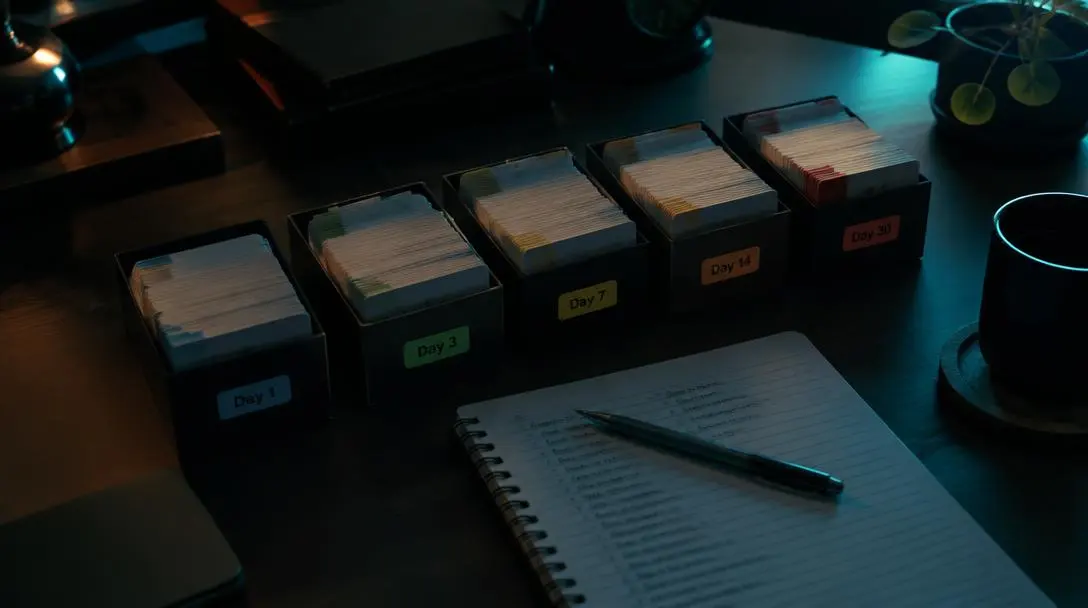
This is where spaced repetition comes in. Instead of cramming a chapter for six hours straight and never touching it again until pre-board exams in January, you review the material across expanding intervals: Day 1, Day 3, Day 7, Day 21, and Day 60. By pairing spaced intervals with the active recall study method, you interrupt the forgetting curve precisely when your brain is about to let the memory slip.
### A Practical 4-Box Leitner System for Pakistani Students
You do not need an internet connection or specialised software to run a spaced repetition schedule. You can set up a physical Leitner box using four cut-out cardboard shoe boxes or empty envelopes labeled Box 1 to Box 4:
- 1Box 1 (Daily): Place all newly created question cards here. Test yourself on these cards every single evening.
- 2Box 2 (Every 3 Days): When you answer a Box 1 card correctly without hesitation, move it to Box 2. Review Box 2 twice a week.
- 3Box 3 (Once a Week): If you answer a Box 2 card correctly, promote it to Box 3. Review this box every Sunday.
- 4Box 4 (Once a Month): Cards answered correctly in Box 3 move here. Review them once a month before terminal and board exams.
- 5The Golden Rule: The moment you fail to answer a card from Box 2, 3, or 4 correctly, it drops back to Box 1 immediately. No exceptions.
This low-tech physical system ensures you spend 80% of your daily study time testing yourself on your weakest topics, rather than wasting hours rereading chapters you already understand.
How to Memorise Faster: Physical Index Cards vs Digital Apps
Students asking how to memorise faster often debate whether to use physical paper cards or digital apps like Anki. Both have distinct trade-offs in Pakistan.
### Physical Index Cards
You can buy plain cardstock or unruled index cards at stationery markets like Urdu Bazaar in Karachi or Urdu Bazar in Lahore. A pack of 100 cards typically costs between PKR 250 and PKR 500 depending on paper thickness. You can also make your own by cutting leftover A4 rim sheets into fourths.
- Pros: No screen distractions, fully usable during load-shedding, excellent for practicing hand-drawn board diagrams and mathematical derivations.
- Cons: Bulky to carry around coaching centres; cards can tear or get disorganized over an 8-month academic year.
### Digital Flashcards (Anki)
Anki is an open-source spaced repetition application that automates your review intervals using a built-in algorithm. It is completely free on Windows, macOS, and Android (AnkiDroid). However, the official iOS app for iPhone users costs roughly PKR 7,500 to PKR 8,500 ($24.99) on the App Store depending on the current exchange rate.
- Pros: Stores thousands of questions in your pocket; automatically schedules which cards you must review each day based on your difficulty ratings.
- Cons: High distraction potential from social media notifications; difficult to input lengthy Urdu or complex organic chemistry reaction mechanisms without a stylus.
For most students in matric and intermediate, a hybrid approach works best: use paper cards for physics derivations, mathematics formulas, and biology diagrams; use digital cards on your phone for English vocabulary, multiple-choice questions (MCQs), and objective dates in Pakistan Studies.
Drawbacks, Mental Fatigue, and When Active Recall Fails
Active recall is not a magic shortcut. It comes with trade-offs that coaching centres rarely explain to students:
- Severe Mental Exhaustion: Active retrieval demands intense cognitive energy. Forty-five minutes of testing yourself on organic chemistry mechanisms will leave you more tired than three hours of passive reading. If you try to do five consecutive hours of active recall, your brain will shut down. Keep sessions to 45-minute focused sprints followed by 10-minute breaks.
- Ineffective for Initial Conceptual Comprehension: Active recall tests what is already in your brain; it cannot teach you something you never understood in the first place. If you do not understand the conceptual foundation of Faraday's Law or stoichiometry, attempting to memorize questions will only lead back to blind ratta. First, master the core concept through your teacher, a textbook, or targeted courses. Once understood, use active recall to lock it into memory.
- Not Ideal for Full-Length Essay Structuring: While question cards excel at facts, definitions, and short questions, they do not train the physical endurance needed to write an 8-page Urdu essay or an extensive Pakistan Studies response in 25 minutes. For long-form sections, pair active recall with timed, pen-and-paper past paper drills from our blog resources.
Building an 8-Week Board Exam Revision Schedule
To implement these revision techniques effectively before your annual board or college preliminary exams, organize your remaining weeks systematically:
- Weeks 1 to 3 (Card Generation & Daily Review): Go through your syllabus chapter by chapter. Stop making long notes. Create 15 to 25 question cards per chapter. Review Box 1 daily.
- Weeks 4 to 6 (Spaced Maintenance & Past Papers): Run your Box 2 and Box 3 reviews consistently. Begin solving unassisted 5-year past paper questions under timed conditions on weekends. Any question you fail in a past paper immediately becomes a new card in Box 1.
- Weeks 7 to 8 (Final Retrieval Consolidation): Put away all textbooks. Spend 70% of your study time clearing Box 3 and Box 4 cards, and 30% of your time writing full mock papers by hand to build handwriting speed and presentation neatness for the board examiners.
By abandoning comfortable, passive rereading and embracing the active recall study method, you stop relying on exam-day luck. You enter the examination hall knowing that every formula, diagram, and definition has already been retrieved from your memory dozens of times.
Questions students ask about this topic
Keep reading
- Study SkillsBuilding a Study Plan That Survives a Full School DayMost timetables fail in week two because they assume unlimited energy. Here is how to design a plan around the hours you actually have, and how to rebuild it when it breaks.
- Study SkillsStudying Online Safely: Privacy, Scams and Screen DisciplineOnline study is now the default for Class 9–12 students in Pakistan. Here is how to protect your accounts, spot education scams and keep your phone from eating your revision.
- Study SkillsA Class 9 Study Routine That Survives a Full School DayMost Class 9 timetables collapse in three weeks because they are built for an imaginary student. Here is a routine built around a real Karachi school day, tuition and all.