How to Improve English for Board Exams and Entry Tests
A practical guide for Pakistani matric, inter, and A-Level students preparing English for board papers and competitive university entrance exams.
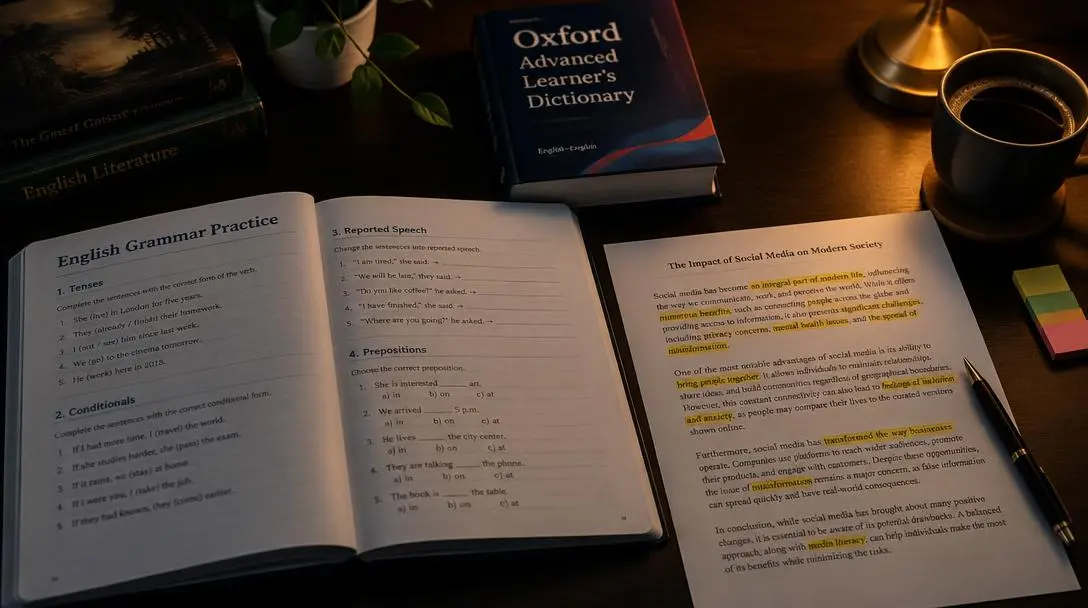
Most students in Karachi spend eleven months drilling organic chemistry mechanisms, calculus problems, and physics derivations. English is relegated to the final three weeks before board exams. You buy a five-year solved past paper series from Urdu Bazaar, memorise four standard essays on 'An Ideal Student' or 'A Cricket Match', cram twenty idioms, and hope for an A-one grade. In matric and intermediate, this tactic often scrapes you through. Then university entrance test season arrives.
Suddenly, you sit for the IBA aptitude test, the MDCAT, the NED entrance test, or the NUST NET. The English section does not ask you to reproduce a summary of a Wordsworth poem. Instead, it hits you with complex reading comprehension, nuanced sentence completions, and obscure prepositional phrases. If you want to know how to improve English for exams across both school boards and high-stakes university admissions, you must change how you study the subject from the ground up.
English is a skill, not a content subject. Treating it like Pakistan Studies will guarantee a low percentile on aptitude day. Here is the operational strategy to bridge grammar gaps, develop an efficient reading habit, use structural essay templates, and align your board prep with university entry requirements.
How to Improve English for Exams by Fixing Core Grammar Gaps
Pakistani boards—whether you are enrolled in the Sindh Board (BIEK/BSEK) or the Federal Board (FBISE)—reward pattern recognition, whereas entry tests reward diagnostic understanding. When you begin your English grammar practice, avoid opening a heavy rules-based grammar guide to read it front to back. Target the specific structural faults that examiners penalise repeatedly.
First, master subject-verb agreement with compound subjects and intervening phrases. A classic board and entry test trap places a prepositional phrase between the subject and the verb: *'The collection of modern Pakistani paintings (was/were) auctioned in Clifton.'* Many students look at the plural noun 'paintings' and pick 'were', completely missing the singular head noun 'collection'.
Second, dissect verb tenses and conditionals. Board papers in Sindh frequently test direct and indirect speech along with active and passive voice through formulaic sentences. FBISE and university aptitude tests test functional sequencing: knowing when to use the past perfect versus the simple past, or correctly framing the third conditional (*'If she had revised the past papers, she would have cleared the cut-off'*).
Third, tackle dependent prepositions. Pakistani students routinely translate prepositions directly from Urdu or Sindhi into English. This leads to common errors like writing *'He discussed about the issue'* instead of *'He discussed the issue'*, or *'congratulated for'* instead of *'congratulated on'*. Keep a dedicated notebook where you log fixed preposition pairings alongside an example sentence.
High test scores do not require you to memorise obscure 18th-century grammatical rules. They require complete mastery over subject-verb agreement, tense consistency, modifier placement, and fixed prepositions.
The Reading Habit: Moving Beyond Karachi Past Papers
Relying solely on guidebooks sold around Saddar will leave your comprehension speed far below the threshold needed for competitive exams. MDCAT requires you to process dense questions under severe time pressure; the IBA test features multi-paragraph analytical reading passages that demand rapid inference skills.
You do not need to read classic Victorian literature to build this capacity. A focused, 20-minute daily reading routine using credible non-fiction will deliver better results. Read the editorial and opinion pages of major national English dailies such as *Dawn* or *The Express Tribune*.
Do not read passively as if you are scrolling through social media. Read with a pencil or digital highlighter, and execute three distinct tasks:
- Identify the central thesis: Summarise the main argument of the editorial in a single, original sentence.
- Track the tone: Decide whether the writer is critical, objective, cautionary, or optimistic about the issue.
- Extract context clues: When you encounter an unfamiliar word, do not reach for a dictionary immediately. Read the preceding and succeeding sentences to deduce the general meaning before verifying it.
Reading contemporary Pakistani commentary exposes you to mature sentence architecture while keeping you informed on national economic and social topics. This dual focus directly feeds into your essay writing modules and general knowledge sections. Explore more targeted learning techniques in our resources section.
Vocabulary Building That Actually Sticks
The standard advice given to college students in Karachi is to purchase a 3,500-word GRE wordlist and memorise it alphabetically. This is ineffective. By the time you reach the letter 'E', you have forgotten half of the words beginning with 'A'. Furthermore, knowing a dictionary definition does not mean you understand the word's precise connotation.
For sustainable vocabulary building, shift to a contextual, root-based approach:
- 1Learn Latin and Greek roots: Understanding that *mal* means bad (*malice*, *malevolent*, *malady*) or *cred* means believe (*credible*, *credulous*, *incredulity*) allows you to decipher unfamiliar words on the fly during an aptitude test.
- 2Group words by theme: Instead of alphabetical lists, study words in thematic clusters. Group words that describe praise (*laud*, *acclaim*, *extol*, *eulogise*) or words that describe brevity (*terse*, *laconic*, *succinct*). Note the subtle differences in formality and intensity between them.
- 3Use digital spaced repetition: Download an open-source spaced-repetition application like Anki. Create digital flashcards that feature the target word, its part of speech, a concise definition, and the exact sentence in which you originally found it.
Review these cards during your daily commute on the bus or during break intervals at college. Ten minutes of systematic spaced repetition every day produces far better retention than four hours of frantic cramming on a Sunday night.
Essay Writing Tips and Structural Templates
Essay marking schemes vary significantly across Pakistani testing bodies. Sindh Board examiners often prioritise essay length, legible presentation, and traditional quotations. FBISE and university admissions committees look for logical progression, clear topic sentences, and structural cohesion.
To satisfy both ends of the spectrum, apply these core essay writing tips using a balanced 5-paragraph framework:
- Paragraph 1: Introduction and Thesis. Start with a broad contextual sentence, narrow down to the specific problem, and end with an explicit thesis statement that outlines your primary arguments.
- Paragraphs 2 to 4: Body Paragraphs. Every body paragraph must begin with a clear topic sentence. Follow that sentence with concrete evidence, a real-world example (such as renewable energy initiatives or educational disparity in rural Sindh), an analytical explanation, and a concluding transition into the next point.
- Paragraph 5: Conclusion. Summarise your main claims using fresh vocabulary, restate the significance of your thesis, and present a balanced, forward-looking recommendation. Never introduce entirely new evidence in your final paragraph.
Avoid flowery, overly dramatic language. Sentences like *'Since the dawn of human civilisation, education has been a luminous beacon'* sound hollow. Replace them with precise, grounded prose: *'Over the past two decades, investment in primary education has emerged as a fundamental driver of regional economic resilience.'* Precision always beats ornamentation.
Board Exam English vs University Entry Tests
Understanding the differences between your college syllabus and an entrance examination allows you to prepare for both without doubling your workload. The table below illustrates where the two formats diverge and where they overlap.
| Feature | Sindh Board (BIEK) / Matric | Federal Board (FBISE) | University Entry Tests (IBA, MDCAT, NET) | :--- | :--- | :--- | :--- | Primary Goal | Syllabus completion & rote recall | Conceptual application & SLOMs | Diagnostic screening & speed filtering | Grammar Testing | Direct conversion (voice, speech) | Contextual error identification | Sentence correction & syntax analysis | Vocabulary Focus | Textbook glossary items | Contextual comprehension questions | High-frequency academic word usage | Reading Format | Familiar prose passages from text | Unseen short comprehension texts | Complex, multi-paragraph unseen passages | Writing Task | Fixed-length descriptive essays | Guided analytical/reflective writing | Timed persuasive essays or analytical tasks | Scoring Pressure | High marks common with neatness | Scaled objectively via rubric | High negative marking / severe cut-offs |
|---|
Notice the natural progression: FBISE acts as an intermediate bridge between rote board formats and the diagnostic nature of entrance tests. If you are enrolled in the Sindh Board, you must deliberately seek out unseen comprehension passages to make up for the syllabus's heavy focus on prescribed textbook stories. You can browse our courses directory to find structured English preparatory tracks that match these specific test criteria.
A 12-Week Roadmap: How to Improve English for Exams Systematically
Trying to improve your language competency while managing college classes and tuition centres requires an incremental schedule. Allocate 45 minutes daily for 12 weeks following this targeted schedule.
### Weeks 1 to 4: The Grammatical Foundation
Spend your first month eliminating structural errors. Focus entirely on subject-verb agreement, modifier errors, pronoun-antecedent agreement, and core punctuation (particularly apostrophes, semicolons, and comma splices). Complete 15 diagnostic exercises daily. Check your answers immediately against an answer key and write down an explicit explanation for every mistake you make.
### Weeks 5 to 8: Contextual Reading and Lexical Expansion
Shift your focus toward timed reading. Read one comprehensive long-form opinion article every day. Build your thematic vocabulary cards, aiming for 15 new high-frequency academic words per day. Begin working through unseen reading comprehension passages from past papers. Time yourself strictly: allow no more than 8 to 10 minutes per passage, including the associated questions.
### Weeks 9 to 12: Applied Writing and Full-Length Drills
In the final month, produce one complete, timed essay every four days using the 5-paragraph model. Have an English teacher or an experienced peer review your drafts against a standard marking rubric. Simultaneously, complete full-length, timed English test sections under authentic conditions to build the pacing required on exam day. If you are deciding which degree programmes align with your academic profile, evaluate your options via our careers portal.
Common Pitfalls Pakistani Students Must Avoid
First, do not rely on machine translation tools to complete your college homework. Running Urdu thoughts through software generates unnatural English syntax that harms your writing style over time. Think directly in complete English phrases, even if your early drafts are simple.
Second, stop treating vocabulary as an ornament. Many students search for long, complex synonyms to make their essays look scholarly. Examiners see through this instantly. If a simpler word conveys your meaning accurately, choose the simpler word every time. Clarity and logical coherence will consistently secure higher marks than awkward attempts at grandiloquence.
Finally, do not isolate English preparation to exam week. Consistent exposure over three months will permanently raise your linguistic baseline, securing your high school grades while opening doors to competitive universities across Pakistan. Check our blog for additional study schedules, and test your current baseline using our diagnostic quiz.
Questions students ask about this topic
Keep reading
- Study SkillsBuilding a Study Plan That Survives a Full School DayMost timetables fail in week two because they assume unlimited energy. Here is how to design a plan around the hours you actually have, and how to rebuild it when it breaks.
- Study SkillsStudying Online Safely: Privacy, Scams and Screen DisciplineOnline study is now the default for Class 9–12 students in Pakistan. Here is how to protect your accounts, spot education scams and keep your phone from eating your revision.
- Study SkillsA Class 9 Study Routine That Survives a Full School DayMost Class 9 timetables collapse in three weeks because they are built for an imaginary student. Here is a routine built around a real Karachi school day, tuition and all.