How to Write Board Exam Answers Examiners Reward
Learn how examiners grade Matric and Intermediate papers in Pakistan, and master the exact formatting, diagram, and structuring techniques that secure top marks.
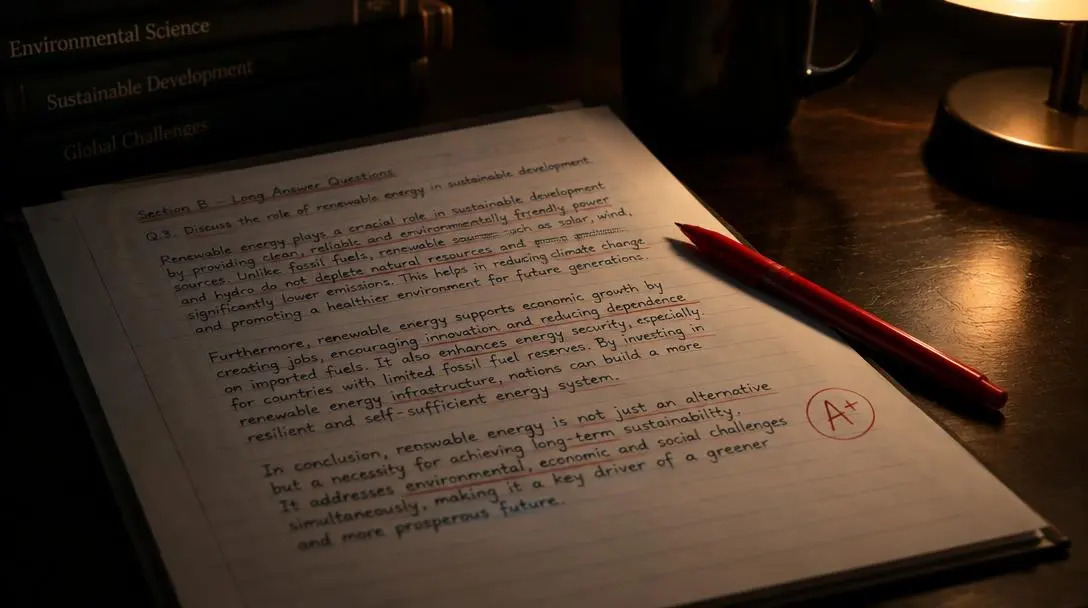
Every year, thousands of students walk out of examination halls across Karachi, Rawalpindi, and Lahore convinced they scored above ninety percent, only to discover a disappointing grade on result day. The issue is rarely a lack of preparation. More often, it comes down to how that knowledge appears on paper. If you want to convert your revision into top-tier grades, you must master practical board exam answer writing tips that cater directly to the examiner checking your sheet.
Exam assessment in Pakistan is a high-volume, repetitive task. Whether your script lands at a Board of Intermediate Education Karachi (BIEK) assessment centre or passes through the Federal Board (FBISE) on-screen e-marking system, the reality is identical: a human examiner spends between two to four minutes evaluating your entire multi-page script. Understanding how to present information so that marks can be awarded effortlessly is the single most valuable skill you can acquire before stepping into the exam hall.
The Examiner's Reality: How Papers Are Actually Marked
To write winning answers, you have to understand the person holding the red pen. In board assessment centres across Sindh and Punjab, examiners are assigned bundles of fifty to one hundred scripts a day. They are paid a modest fee per script—often between PKR 40 and PKR 90 depending on the board and level (Matric or Inter)—and they work under strict submission deadlines. Mental fatigue sets in rapidly.
When an examiner opens your script, they are not reading your prose like a novel. They are scanning for specific grading cues: keywords from the national curriculum or textbook board syllabus, labelled diagrams, formulas, correct units, and clear subheadings. If your paper presents a dense, unbroken wall of blue ink, you force the examiner to read line by line to locate the marks. If they miss a point in your paragraph, you lose the mark.
An examiner will never hunt through messy paragraphs to find your correct point. If an answer cannot be verified within ten seconds of scanning, you risk losing marks regardless of how hard you studied.
The transition towards SLO-based (Student Learning Outcomes) testing in the Federal Board and recent reforms in Sindh boards make this even more critical. Evaluation rubrics award marks for individual components: one mark for the definition, one for the formula, one for the SI unit, and two for the derivation. Your layout must reflect this exact division.
Time Allocation: Calculating Minutes per Mark
A frequent reason candidates fail to complete their scripts is poor time budgeting. Panic sets in during Section C (long questions) simply because too much time was spent making Section B (short questions) unnecessarily long. Learning how to attempt board paper requirements systematically requires an exact mathematical plan before you write your roll number.
A standard three-hour theory paper gives you 180 minutes for 85 to 100 marks. Set aside fifteen minutes: five minutes at the beginning to scan the paper and select your optional questions, and ten minutes at the end to check question numbers, tie supplemental sheets (if using Sindh Board physical copies), and verify units. That leaves 165 usable minutes.
Divide your remaining time by the total marks on the paper. In an 85-mark paper (standard for Class 11 and 12 Physics or Chemistry in Karachi), you have approximately 1.9 minutes per mark. Apply this rule strictly:
- 3-Mark Short Question: 5 to 6 minutes maximum.
- 4-Mark Question: 7 to 8 minutes maximum.
- 8-Mark Long Question: 15 to 16 minutes maximum.
If your allocated time expires on a question, leave several blank lines and move immediately to the next one. You can return during your ten-minute buffer. Sacrificing an entire eight-mark question at the end because you spent twenty minutes perfecting a three-mark definition is the fastest route to dropping a letter grade.
Essential Board Exam Answer Writing Tips for Short Questions
Section B tests precision, not length. Students often mistakenly believe that writing two full pages for a short question guarantees full marks. In reality, examiners deduct marks for irrelevant padding. Apply these focused board exam answer writing tips to handle short questions efficiently:
- 1Start with the Core Definition: Begin your answer with the precise textbook definition, centered or indented, using a black pen or dark blue ink. Do not write introductory filler such as 'We know that from Physics...'.
- 2State Formulae and SI Units Clearly: If a concept involves a mathematical expression, write it on its own line. Always specify the SI unit and dimensional formula if applicable. For instance, in answering a question on Electric Flux, state the formula $\Phi = \vec{E} \cdot \vec{A}$, identify each variable, and state $\text{N}\cdot\text{m}^2/\text{C}$.
- 3Use Bullet Points for Reasons: For conceptual reasoning questions (e.g., 'Why does a cricketer lower his hands while catching a ball?'), use two or three numbered bullet points detailing the impulse-momentum relationship, the increase in impact time, and the resulting reduction in force.
- 4Draw a Micro-Diagram: Even if not explicitly requested, a small, two-inch labelled sketch (such as a ray diagram in Optics or a simple circuit diagram) confirms your understanding instantly and safeguards your marks.
Long Question Structure: The Step-by-Step Blueprint
Handling Section C demands an organised framework. An examiner grading a comprehensive question on the Carnot Engine, DNA Replication, or the 1973 Constitution expects an orderly, logical progression. Developing a reliable long question structure guarantees that you cover every scoring requirement without rambling.
Follow this structural hierarchy for descriptive long answers:
### 1. Main Heading and Overview
Write the question topic in bold capitals using a 605 cut marker. Immediately below, write a two-line overview defining the scope of the answer. This signals competence immediately.
### 2. Theoretical Principle or Statement
State the governing law, principle, or historical context. Keep this to four or five lines of precise, formal English. Ensure board-specific terminology is spelt correctly.
### 3. Construction or Derivation Steps
Break your derivation into clear mathematical steps. Never lump equations together on a single line. Number your equations sequentially on the right-hand margin. If introducing assumptions, list them under a dedicated bulleted subheading.
### 4. Tabulated Data and Graphical Representation
Where applicable, present comparison points or experimental data in a neat table. If a graph is required, sketch the axes clearly, label the physical quantities along with units, and draw the curve accurately.
### 5. Final Result and Significance
Conclude your long answer by boxing your final equation or summarizing the historical or biological conclusion. A boxed answer at the end of a derivation acts as a visual anchor for the marking examiner.
Diagrams and Flowcharts: Unlocking Exam Presentation Marks
Examiners frequently award exam presentation marks indirectly through visual clarity. A paper with clear, legible illustrations stands out instantly against hundreds of pages of continuous handwriting.
In Pakistani boards, diagram presentation rules depend on the board format. For Federal Board e-marking, scripts are scanned in black and white at 200 to 300 DPI. If you draw diagrams using faint 2H pencil lead, the scanner will wash out your lines, leaving the e-marker with an invisible drawing. For FBISE, sketch diagrams using an HB pencil with firm pressure, or trace your final lines with a dark black ballpoint pen. For Sindh Board (BSEK/BIEK), clean pencil sketches with clear, horizontal label lines remain standard.
Follow these visual rules on every script:
- Always box your diagrams using a ruler.
- Align your labels on the right-hand side using parallel guide lines rather than crossing arrows over the illustration.
- Use simple block flowcharts for processes (e.g., Nitrogen Cycle, Industrial preparation of Nitric Acid via Ostwald's Process).
- Underline main headings with a single clean stroke. Avoid double decorative wavy lines; they look childish and waste valuable seconds.
Board Exam Answer Writing Tips by Subject: Sciences vs Humanities
Different subjects require completely different approaches to secure top marks. Writing an essay-style answer for a Chemistry paper will cost you marks, just as providing isolated bullet points without prose will lower your score in an English literature question.
| Parameter | Science Subjects (Phy, Chem, Bio) | Humanities & Languages (Pak Studies, Islamiat, Urdu) | Mathematics |
|---|---|---|---|
| Primary Focus | Terminology, derivations, SI units, accuracy | Historical facts, chronological flow, quotations | Logical sequence, intermediate steps, final value |
| Format | Bullet points, equations, labelled diagrams | Extended paragraphs anchored by strong subheadings | Step-by-step vertical working; no skipped steps |
| Visual Elements | Circuit diagrams, chemical structures, graphs | Timeline tables, boxed Quranic verses/Hadith references | Clear geometric constructions, boxed answers |
| Marker Usage | Minimal: formulas and section labels only | Frequent: quotes, dates, names of treaties or scholars | Equations and final statements only |
For Pakistan Studies and Islamiat (compulsory subjects for intermediate students across Sindh and Federal boards), quotations are mandatory for high marks. Write Quranic Ayahs or Hadith references in Arabic only if you are certain of the spelling and diacritics (Aerab). If you are unsure, write the authentic English or Urdu translation cleanly, placing it within quotation marks, centered on the page.
The Deductions Hitlist: What Triggers Red Ink
Understanding what frustrates examiners helps you prevent unforced errors. Over decades of board marking, examiners report the same recurring mistakes leading to mark deductions:
- Changing Question Numbering: Never renumber questions to fit your preferences. If you are answering Question 2, Part (iv) from the question paper, write precisely Q2 - Part (iv). Renumbering it as 'Answer 1' forces the examiner to check the master paper, creating frustration that reflects in your marks.
- Overwriting and Crossing Out: If you make a mistake, draw a single, clean horizontal line through the incorrect word or formula. Do not scribble vigorously over the text or use white correction fluid. Liquid paper is officially prohibited in most Pakistani board halls and can lead to penalties if flagged by checking committees.
- Missing Physical Units: Arriving at the correct numerical answer (e.g., $4.5$) without stating the unit (e.g., $\text{ms}^{-1}$ or Joules) results in an automatic half-mark or full-mark deduction across all boards.
- Mixing Languages: Avoid using informal romanized Urdu terms within English-medium papers. Maintain formal academic English throughout.
- Unanchored Supplemental Sheets: In BIEK examinations where physical answer sheets (extra copies) are added, write your roll number and the supplement number clearly. Fasten them securely using the provided twine. Examiners will not chase down loose pages that tear away in transit to the evaluation center.
The Final Review Routine: What to Do in the Last 10 Minutes
When the warning bell rings ten minutes before the end of your paper, stop writing new answers. Pushing yourself to start another question with five minutes left usually yields an incomplete, scrambled answer that scores zero or one mark, while preventing you from fixing critical mistakes in the work you have already completed.
Spend your final ten minutes executing this quality check:
- 1Check Question Sub-parts: Verify that you have attempted the exact number of required questions from each section. If the section asks for 'Attempt any 6 out of 8', confirm you have not accidentally left the section at five.
- 2Confirm Question Labels: Match every answer number against the printed question sheet to guarantee absolute alignment.
- 3Inspect Formulas and Units: Scan your numerical answers in Physics, Chemistry, and General Maths. Verify that decimal points are clearly visible and every final number has its respective unit attached.
- 4Draw Section Dividers: Using a pencil and ruler, draw a neat line across the page at the end of each completed question. This makes it impossible for an examiner to overlook where one answer ends and the next begins.
Board exams in Pakistan do not just test what you understand; they test your discipline under time pressure. By approaching your paper with structure, visual clarity, and respect for the examiner's time, you separate yourself from the average cohort and place your script firmly in the highest mark bracket.
Questions students ask about this topic
Keep reading
- Study SkillsBuilding a Study Plan That Survives a Full School DayMost timetables fail in week two because they assume unlimited energy. Here is how to design a plan around the hours you actually have, and how to rebuild it when it breaks.
- Study SkillsStudying Online Safely: Privacy, Scams and Screen DisciplineOnline study is now the default for Class 9–12 students in Pakistan. Here is how to protect your accounts, spot education scams and keep your phone from eating your revision.
- Study SkillsA Class 9 Study Routine That Survives a Full School DayMost Class 9 timetables collapse in three weeks because they are built for an imaginary student. Here is a routine built around a real Karachi school day, tuition and all.