Note-Taking Methods That Work for Board Syllabi
Ditch passive transcription. Learn practical note-taking methods designed for Pakistani matric, intermediate, and A Level syllabi to cut revision time in half.
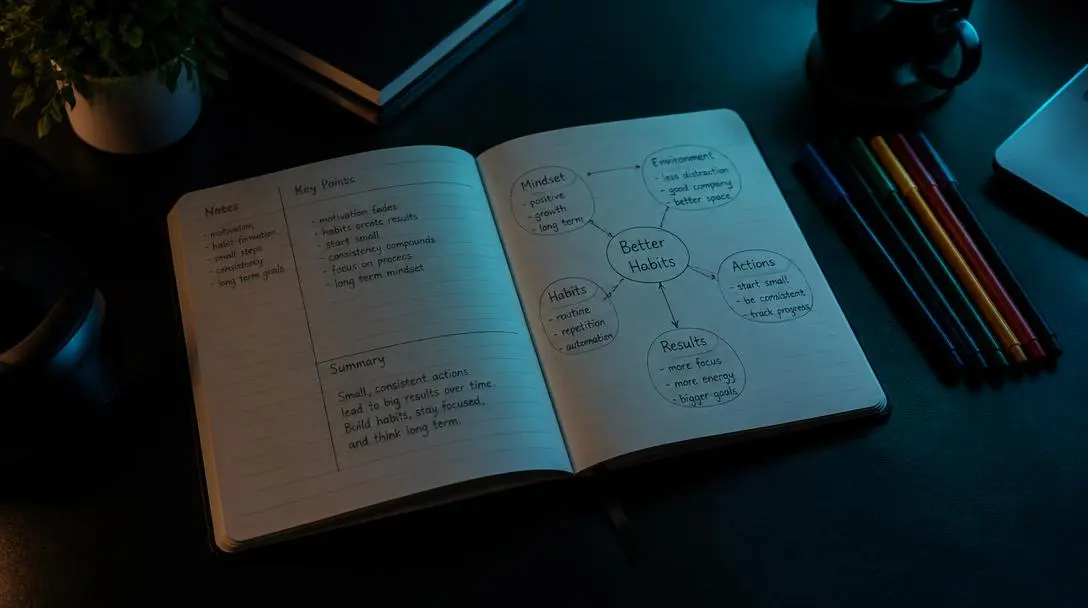
Every September across Karachi, from coaching centres in Gulshan-e-Iqbal to colleges along North Nazimabad, students buy thick, hardbound registers and begin copying the whiteboard word for word. By January, those registers contain three hundred pages of dense blue ink. By March, when board exams approach, those same students stop reading them entirely and buy solved past paper booklets from Urdu Bazaar instead. Understanding effective note taking methods for students is the difference between retaining a massive syllabus and drowning in handwriting you will never open again.
The standard approach in Pakistani matriculation and intermediate institutions rewards passive transcription. Teachers dictate solved textbook exercises, coaching centres hand out photocopied model answers, and students assume that writing something down equates to learning it. It does not. If your notes merely duplicate the Sindh Textbook Board or National Book Foundation textbook, you have wasted hours on manual photocopying.
To survive the grading criteria of the Board of Intermediate Education Karachi (BIEK), the Federal Board (FBISE), or Cambridge CAIE, your notes must serve a clear purpose: active retrieval and rapid pre-exam revision. Here is how to build a note-taking engine that directly targets board paper marking schemes.
Why Traditional Note Taking Methods for Students Fail Board Exams
Pakistani board examinations test two distinct cognitive skills: verbatim factual recall (standard definitions, historical dates, scientific laws) and rigid structural presentation (headings, diagrams, mathematical steps). Traditional student notes fail because they jumble these requirements into long, unstructured narrative paragraphs.
When an examiner marks an intermediate Chemistry paper, they scan the page for specific technical markers: state symbols, balanced equations, IUPAC nomenclature, and underlined subheadings. If your revision materials are written in continuous paragraphs, your eye cannot locate these markers during a rushed revision session forty-eight hours before the paper.
Furthermore, copying out full answers ignores cognitive load. When you copy sentences, your brain processes the grammar, not the concept. You feel tired and productive, yet two days later, you cannot recall the conditions for the Haber process or the key clauses of the 1973 Constitution.
Adapting Cornell Notes for BIEK and Federal Board
The Cornell system is one of the most reliable frameworks for high-volume academic syllabi, but it needs slight adjustments to handle Pakistani board marking schemes. In a standard Cornell layout, you divide your page into three sections: a narrow left column (the cue column), a wide right column (the notes area), and a bottom band (the summary).
For board exams, adapt these sections to reflect past paper structures:
- The Right Column (Content & Equations): Record your core notes here during class or textbook study. Use short phrases, clear bullets, balanced chemical reactions, and fully worked physics steps. Do not write complete sentences unless it is an exact, unalterable definition required by your board.
- The Left Column (Past Paper Prompts & Marks): Instead of simple cues, write actual past paper questions here. For example, next to your notes on projectile motion, write: *'Define trajectory and derive expression for maximum height (BIEK 2018, 5 marks)'*. When revising, cover the right side and practice answering the prompt on scrap paper.
- The Bottom Section (Examiner Checklist): Reserve this three-to-four-line band at the bottom of each page for essential marking criteria. List the diagrams that must accompany this answer, specific constants, or standard headings required by board checkers.
A completed Cornell page should function as an exam simulation sheet. If you cannot recite the right-hand column using only the left-hand prompts, you do not know the material well enough for an A-1 grade.
Mind Mapping for High-Volume Theory
Subjects like Pakistan Studies, Biology, and Islamiat present a different challenge: massive volumes of interconnected historical details or anatomical systems. Linear notes often break down here because you cannot see the chronological sequence or physiological hierarchy on a single page.
A mind map starts with the central theme in the middle of a blank sheet (turned horizontally) and branches outward into major categories, sub-categories, and specific data points. This visual structure works exceptionally well for specific board challenges:
- 1Pakistan Studies (Class 9 & 11): Place a major historical era in the centre—such as the *Constitutional Developments (1947–1956)*. Major branches represent successive draft reports, while secondary twigs list specific controversies (language issues, representation formulas). This allows you to review an eight-mark question at a single glance.
- 2Biology (Botany & Zoology): Use maps for physiological cycles and classification trees. Rather than copying twelve pages on the kingdom Plantae, create an branching hierarchy that lists division names, reproductive features, vascular traits, and textbook examples.
Mind mapping forces you to categorise information actively before you write it down. The main downside is that it does not accommodate long mathematical derivations. Keep mind maps for structural overviews and use them alongside your regular linear registers.
The Three-Stage Condensation Cycle
No student can realistically re-read three hundred pages of detailed notes during the gap days between board papers. The solution is the condensation cycle: deliberately reducing your notes across the academic year from comprehensive drafts down to exam-eve cue sheets.
This cycle consists of three clear stages:
### Stage 1: The Master Deck (Months 1–5)
These are your comprehensive working notes, compiled during regular term time from your textbooks, college lectures, and coaching sessions. They contain full derivations, complete chemical reaction mechanisms, and every diagram drawn cleanly with an HB pencil. A single subject's master deck typically spans 150 to 250 pages.
### Stage 2: The Topic Summary Sheets (Months 6–8)
During pre-board preparation, reduce each chapter to two double-sided A4 sheets. Strip out explanatory prose. Retain only governing equations, core definitions that cannot be altered, flowcharts of processes, and lists of critical headings. If you understand how a derivation works, do not rewrite every intermediate algebraic step; note only the starting premise and the final expression.
### Stage 3: The 24-Hour Cheat Sheet (Final Month)
Two weeks before the board examinations begin, condense each subject onto three to four pages maximum. These contain exclusively the details you are at risk of forgetting under pressure: numerical values of constants, anomalous oxidation states, years of minor treaties, and specific biological nomenclature.
Comparing Note Taking Methods for Students Across Core Subjects
Different subjects demand fundamentally different organisational structures. Using Cornell notes for organic reaction mechanisms is just as inefficient as using linear bullet points for historical chronologies. Match your method to the syllabus using the comparison below:
| Method | Best Pakistani Subjects | Key Advantages | Major Limitations | Time Investment |
|---|---|---|---|---|
| Modified Cornell | Physics, Chemistry, English | Directly mirrors past paper questions; perfect for self-testing | Requires structured page setup; slower during live lectures | Moderate |
| Mind Mapping | Pakistan Studies, Biology, Islamiat | Shows topic relationships; fits entire chapters on one page | Cannot handle derivations; messy if not planned well | Low to Moderate |
| Linear Headings | Urdu, Islamic History, Computer Science | Clean presentation; mirrors board answer sheets directly | Prone to mindless copying; hard to revise rapidly | Low |
| Formula / Chart Sheets | Mathematics, Statistics, Accounting | High-density reference; excellent for gap-day revision | Zero conceptual explanation; useless without base knowledge | Low |
How to Make Notes Directly Aligned with Past Papers
When learning how to make notes for Pakistani boards, your five-year past paper booklet is more critical than your notebook paper. Before you write a single line for any chapter, examine the past five years of board papers for that topic. Identify the recurring patterns:
- Does the examiner ask for the working principle and construction of an apparatus together, or just the mathematical formula?
- Which questions repeat as short questions (Section B) versus detailed response questions (Section C)?
- Where does the textbook text differ from the model answer expected by examiners?
Structure your notes using the exact vocabulary and heading conventions that board checkers expect. In Sindh Board papers, for instance, examiners frequently grade based on the presence of underlined subheadings. If a question on *photosynthesis* requires light reactions, dark reactions, and factors affecting the rate, your notes should use those exact three subheadings in bold marker.
Leave the right margin of your page empty. When your college or coaching centre runs chapter tests, note down where you lost marks in that margin. If an examiner deducted one mark because you forgot the unit of resistance in a numerical problem, write that error in red ink directly next to the formula. You will not repeat the mistake.
Explore our collection of resources for board-specific templates and past paper breakdowns to streamline this process.
The Stationery Trap and Actual Resource Costs
Many students waste considerable money and time on aesthetic stationery—pastel highlighters, expensive imported fineliners, and specialized dotted journals. This habit, often borrowed from social media, provides an illusion of study while consuming valuable revision time.
Board exams in Pakistan are written on plain or ruled paper with low ink absorption, using cheap blue or black ballpoint pens. If you make your notes with delicate 0.38mm gel pens and six shades of highlighters, your muscle memory and visual habits will betray you on exam day in an uncomfortable examination hall.
Keep your equipment practical and affordable:
- Registers: Buy standard local A4-sized spiral registers with 70 to 80 GSM paper (costing roughly Rs. 200 to Rs. 400 depending on page count). Avoid tiny pocket-sized pads.
- Pens: Write with the exact brand and tip size of ballpoint or pointer pen you plan to use in the actual board examination (typically Rs. 20 to Rs. 60 per pen).
- Highlighters: Limit yourself to a single colour (yellow works best). Highlight only key figures, constants, and definitive rules—never full sentences.
If your page looks like an art project, you spent more time decorating than encoding the syllabus into your memory.
For advice on structuring your weekly academic routine alongside these techniques, read through our study planning guides on the blog.
Managing Your Summary Notes for Board Exams During Pre-Boards
The pre-board examination window (typically January to March in Pakistani institutions) is the testing ground for your revision materials. Use these mock exams to identify which parts of your summary notes board exams preparation exposed as weak.
If you sat down for a physics mock and struggled to recall the derivation for the electric potential due to a point charge, your notes failed in one of two ways: either they lacked a clear step-by-step cue in the margin, or you did not test yourself against the cue column during revision.
Do not rewrite your notes from scratch at this stage. Instead, use sticky notes to patch the gaps. Add the missing step or reminder directly onto the relevant page of your Stage 2 summary sheets. Protect your revision time fiercely.
By the time the final exam roll number slip arrives, you should no longer be flipping through 500-page textbooks or relying on unorganised stacks of tuition handouts. You should have a tight, battle-tested stack of thirty to forty condensed pages that you have actively retrieved dozens of times. That level of systematic preparation is what turns intermediate exam stress into predictable academic results.
Questions students ask about this topic
Keep reading
- Study SkillsBuilding a Study Plan That Survives a Full School DayMost timetables fail in week two because they assume unlimited energy. Here is how to design a plan around the hours you actually have, and how to rebuild it when it breaks.
- Study SkillsStudying Online Safely: Privacy, Scams and Screen DisciplineOnline study is now the default for Class 9–12 students in Pakistan. Here is how to protect your accounts, spot education scams and keep your phone from eating your revision.
- Study SkillsA Class 9 Study Routine That Survives a Full School DayMost Class 9 timetables collapse in three weeks because they are built for an imaginary student. Here is a routine built around a real Karachi school day, tuition and all.