A Study Timetable for Class 10 That You Can Actually Keep
Ditch the impossible 14-hour schedules. Here is how Class 10 matric students balance school, tuition centres, and self-study without burning out.
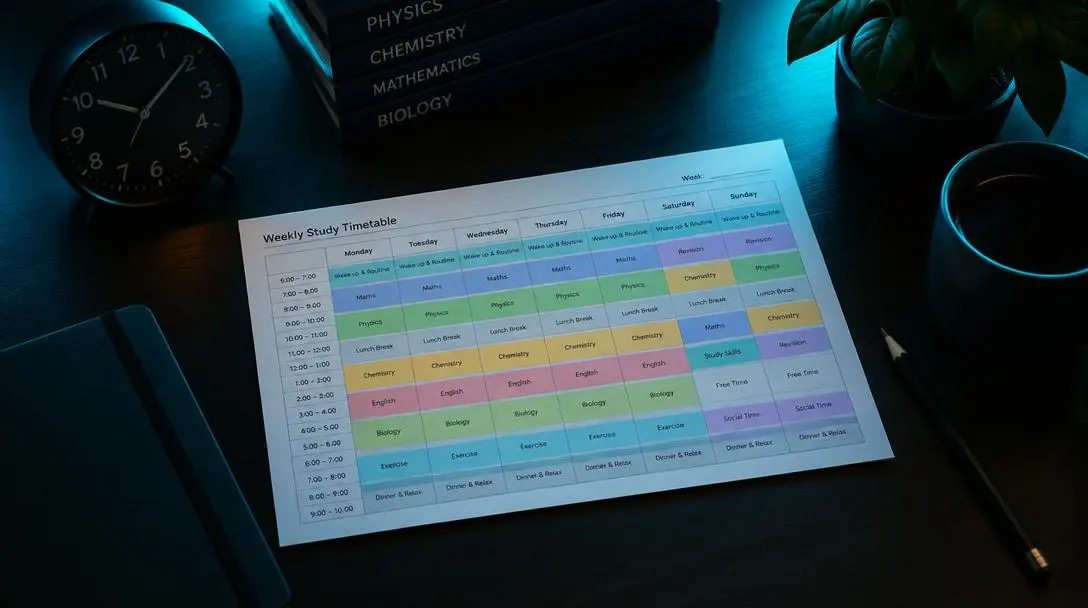
Most toppers do not study fourteen hours a day, despite what your coaching centre teachers or well-meaning relatives might claim. If you are entering Class 10 in Pakistan, you already know the crushing reality of your daily calendar: you wake up at dawn for school, rush home in an overcrowded van, grab a rushed lunch, and head straight out to tuition in Gulshan, North Nazimabad, or Saddar. By the time you get back, your brain feels like fried wire.
Trying to paste a rigid, hour-by-hour schedule onto that chaotic lifestyle is a recipe for failure. If your schedule tells you to do Physics numericals at 8:30 PM, but K-Electric cuts the power or your family decides to visit relatives, your entire week derails. Designing a workable study timetable for class 10 requires building around friction, energy slumps, and real commitments rather than wishful thinking.
Why Most Matric Routines Collapse in the First Week
The standard mistake Class 10 students make is copying a timetable from an internet forum or a senior who sat for exams five years ago. These plans usually budget seven hours of deep revision every evening on top of six hours of school and three hours of coaching. Human physiology does not work that way.
In Class 10, mental fatigue accumulates. When you sit through six periods of lectures at school, followed by rapid-fire past-paper drills at coaching, your working memory is saturated. Expecting yourself to start self-study at 8:00 PM with the enthusiasm of someone who just woke up from an eight-hour nap is unrealistic.
Another structural problem is the lack of buffer time. If your van gets stuck in traffic on University Road or your school assigns sudden project work for Pakistan Studies, a rigid schedule shatters. Once you miss Monday and Tuesday, guilt kicks in, you abandon the paper schedule stuck to your wardrobe door, and you return to panic-cramming late at night.
Calculating Realistic Study Hours Class 10 Students Can Keep
Let us look at your actual non-negotiable hours. An honest audit of your 24 hours cuts through the delusion and shows you exactly what time remains for actual revision.
- School and commute: 07:00 to 14:30 (7.5 hours)
- Decompression and lunch: 14:30 to 15:30 (1 hour)
- Tuition centre and commute: 16:00 to 19:30 (3.5 hours)
- Dinner, family, and hygiene: 19:30 to 20:30 (1 hour)
- Uninterrupted sleep: 23:00 to 06:30 (7.5 hours)
When you add those blocks together, you have spent 20.5 hours. That leaves you with precisely 3.5 hours of discretionary time on a standard weekday. Trying to fit five hours of self-study into a 3.5-hour gap is mathematically impossible, yet students punish themselves for failing to do so.
When mapping out study hours class 10 demands, the target for weekdays should be 2 to 2.5 hours of genuine, focused self-study. On weekends, that number can safely expand to 5 or 6 hours. Two focused hours every evening beating out four hours of distracted, phone-scrolling desk time will put you comfortably in the 80%+ bracket across both BSEK and FBISE boards.
High-intensity study for 120 minutes beats four hours of sleepy page-turning. Your brain stores concepts during focused effort and consolidates them while you sleep.
Energy Mapping: Building a Daily Study Plan That Fits Your Brain
Not all study hours are equal. Solving complex Maths proofs from the Sindhi or Federal textbook requires high cognitive capacity. Memorising long answers for Islamiyat or reviewing Biology diagrams demands a different type of attention.
A resilient daily study plan matches the difficulty of the subject to your natural energy state rather than forcing arbitrary time slots. Most matric students hit three distinct energy phases each day:
- 1The Post-Tuition Slump (20:00 to 21:00): Your focus is weak. Do not attempt raw algebra or new Physics derivations here. Use this window for passive or mechanical tasks: solving straightforward MCQs, making flashcards, copying practical journal notes, or organising past-paper files.
- 2The Second Wind (21:00 to 22:45): After dinner and a short break, your nervous system resets. This is your primary focus window. Tackle your hardest subject here: Physics numericals, Chemistry stoichiometry, or unfamiliar Mathematics chapters.
- 3The Morning Priming Slot (06:00 to 06:40): If you can shift your wake-up time forty minutes earlier, your mind is completely uncluttered. This short window is unmatched for pure recall subjects: Pakistan Studies dates, Biology terminology, or Urdu poetry explanations (ash'aar ki tashreeh).
The School and Tuition Balance: A Practical Matric Study Routine
Coaching academies are an inescapable part of the matric system in cities like Karachi, Hyderabad, and Rawalpindi. Monthly tuition fees run anywhere from PKR 4,000 to upwards of PKR 15,000 per subject group, putting immense financial and emotional pressure on you to show results. But sitting in a coaching academy lecture is not self-study; it is simply secondary instruction.
Here is how a balanced matric study routine looks when contrasted against the typical high-stress fantasy routine:
| Routine Component | The Fantasy Routine (Fails in 1 Week) | The Balanced Routine (Sustainable for Months) |
|---|---|---|
| Weekday Self-Study | 5 to 6 hours every night | 2 to 2.5 focused hours every night |
| Subject Allocation | 4 to 5 subjects every single evening | 2 subjects maximum per evening |
| Tuition Homework | Done late at night between 01:00 and 02:30 | Integrated directly into the 2-hour self-study block |
| Load-Shedding Contingency | None; stops studying when power goes out | Low-tech offline revision files and paper past papers ready |
| Sleep Duration | 4 to 5 hours (leading to daytime brain fog) | 7 to 7.5 hours (mandatory for memory consolidation) |
| Weekend Strategy | Complete rest or panicked 12-hour cram | Structured 3-hour morning blocks + revision review |
Notice the fundamental shift: in the balanced plan, tuition homework is not treated as extra work outside your study hours. It *is* part of your study hours, provided you complete it actively rather than copying answers from a classmate's register.
Step-by-Step Study Timetable for Class 10 (Weekday Model)
Use this framework from Monday to Thursday. It assumes standard morning school hours and late-afternoon coaching sessions. Adjust the timing by thirty minutes depending on your specific commute, but keep the block lengths intact.
### Block 1: The Transition and Admin Slot (20:15 – 21:00)
Start by clearing the small, nagging tasks that clutter your mind. Review what was taught in school and coaching that day. If you were assigned three Chemistry questions at tuition, write them out now while the teacher's explanation is still fresh. Check off any administrative school requirements like practical journals so they do not hang over your head on Sunday evening.
### Break (21:00 – 21:15)
Step away from your desk. Drink water, stretch, or talk to your family. Do not open short-form video reels; fifteen minutes of rapid digital scrolling makes it significantly harder for your prefrontal cortex to refocus on dry textbook material.
### Block 2: The Core Heavy Subject (21:15 – 22:30)
Dedicate this 75-minute period entirely to one challenging analytical subject. Alternate days work best:
- Monday & Wednesday: Mathematics (exercise problems and theorem proofs).
- Tuesday & Thursday: Physics or Chemistry (concepts, solved examples, and 5-year past-paper numericals).
Set a timer. Keep your textbook open alongside your board's solved past-paper guide. Work through at least five distinct questions without looking at the solutions first. Check our curated resources for board-specific model papers if you get stuck.
### Block 3: The Night Wind-Down (22:30 – 23:00)
End the night with light reading. Spend thirty minutes with Pakistan Studies, English grammar, or Urdu prose. Read the texts slowly, underlining key vocabulary and historical figures. When the clock strikes 23:00, stop. Pack your bag for school next morning, turn off your lights, and go to sleep.
The Weekend Recovery and Revision Protocol
Friday afternoon through Sunday evening is where your actual matric grade is decided. Weekdays are for staying afloat; weekends are for pulling ahead. But if you spend all of Saturday sleeping and cramming all of Sunday night, you lose the competitive advantage.
Split your weekend into two productive phases: the morning sprint and the afternoon buffer.
- Saturday Morning (09:00 to 12:00): Devote three solid hours to your weakest subject. For most Class 10 Science students, this is either Maths (General or Science group) or Chemistry. Work without interruption before the household becomes noisy.
- Saturday Afternoon: Take this time completely off. Meet friends, play sports, or spend time with family. You need a cognitive break to prevent mid-term burnout.
- Sunday Morning (09:30 to 12:30): Dedicate this block to language subjects and board-specific compulsory papers. Write out one full Urdu essay (mazmoon) or solve an English comprehension section under timed conditions. Writing speed is a major bottleneck in BSEK and Federal Board exams; practising weekly builds physical hand stamina.
- Sunday Evening (17:00 to 19:00): Run your weekly test simulation. Pick two long-form questions from past papers across any subject and solve them on unlined or board-pattern answer sheets without reference books.
The Weekly Review Loop: How to Adapt When Life Happens
No study timetable for class 10 survives contact with everyday reality unchanged. An unexpected family function, sickness, or sudden gas and electricity disruptions will break your schedule at least once every fortnight. The goal is not to have a flawless streak; the goal is rapid recovery.
Set aside twenty minutes every Sunday at 20:00 for a review loop. Open your notebook and answer three direct questions:
- 1Which subject did I neglect the most this week?
- 2How many actual hours did I spend solving past-paper questions independently?
- 3What friction point ruined my routine this week (e.g., late tuition return, phone distraction, exhaustion)?
If you notice that Physics was skipped on both Tuesday and Thursday because of late coaching dismissals, do not punish yourself by scheduling four hours of Physics on Monday night. Instead, swap Physics into your high-energy weekend slot, or adjust your weekday transition block.
Treat your timetable as a flexible framework rather than a moral test. If you are struggling to decide which academic stream to pursue after matric based on your strengths, exploring different courses and careers early can help you understand which Class 10 subjects warrant the bulk of your revision time.
Board-Specific Tweaks: BSEK vs FBISE Requirements
The way you structure your study sessions should directly reflect the board you are appearing for. BSEK Karachi and Federal Board (FBISE) evaluate students through fundamentally different marking rubrics, and your daily preparation must mirror that reality.
### For BSEK (Karachi Board) Candidates
The Board of Secondary Education Karachi places heavy weight on verbatim syllabus definitions, structured headings, and past-paper patterns from the last five to ten years. Your timetable must prioritize:
- Writing practice with blue and black cut-markers to build the presentation speed required for examiners.
- Memorising standard textbook definitions for Chemistry and Biology exactly as printed in the Sindh Textbook Board (STBB) books.
- Regular drilling of past five-year papers, as question phrasing repeats frequently across consecutive years.
### For FBISE (Federal Board) Candidates
The Federal Board operates on a Student Learning Outcomes (SLO) model. Direct textbook reproduction will not get you an A* or high grade. Your timetable must prioritise:
- Concept-based numerical problems and unfamiliar application questions in Physics and Chemistry.
- Analytical understanding of historical causes and effects in Pakistan Studies rather than rote page-filling.
- Unseen comprehension passages and creative writing exercises in English and Urdu.
Adjust your nightly study blocks accordingly: BSEK students should allocate more time to memory consolidation and written presentation drills, while FBISE students need dedicated blocks for conceptual questioning and supplementary problem sets.
Stick to your adjusted hours for three consistent weeks before making any major changes. Consistency across two hours every single day will outshine erratic six-hour marathons every single time.
Questions students ask about this topic
Keep reading
- Study SkillsBuilding a Study Plan That Survives a Full School DayMost timetables fail in week two because they assume unlimited energy. Here is how to design a plan around the hours you actually have, and how to rebuild it when it breaks.
- Study SkillsStudying Online Safely: Privacy, Scams and Screen DisciplineOnline study is now the default for Class 9–12 students in Pakistan. Here is how to protect your accounts, spot education scams and keep your phone from eating your revision.
- Study SkillsA Class 9 Study Routine That Survives a Full School DayMost Class 9 timetables collapse in three weeks because they are built for an imaginary student. Here is a routine built around a real Karachi school day, tuition and all.